Start here: the one decision that determines all the others
Most espresso machines are bought on price and looks, and most espresso regrets come from exactly that. The machine that photographs well on a kitchen counter and the machine that makes coffee you will still be happy with in a year are often not the same one.
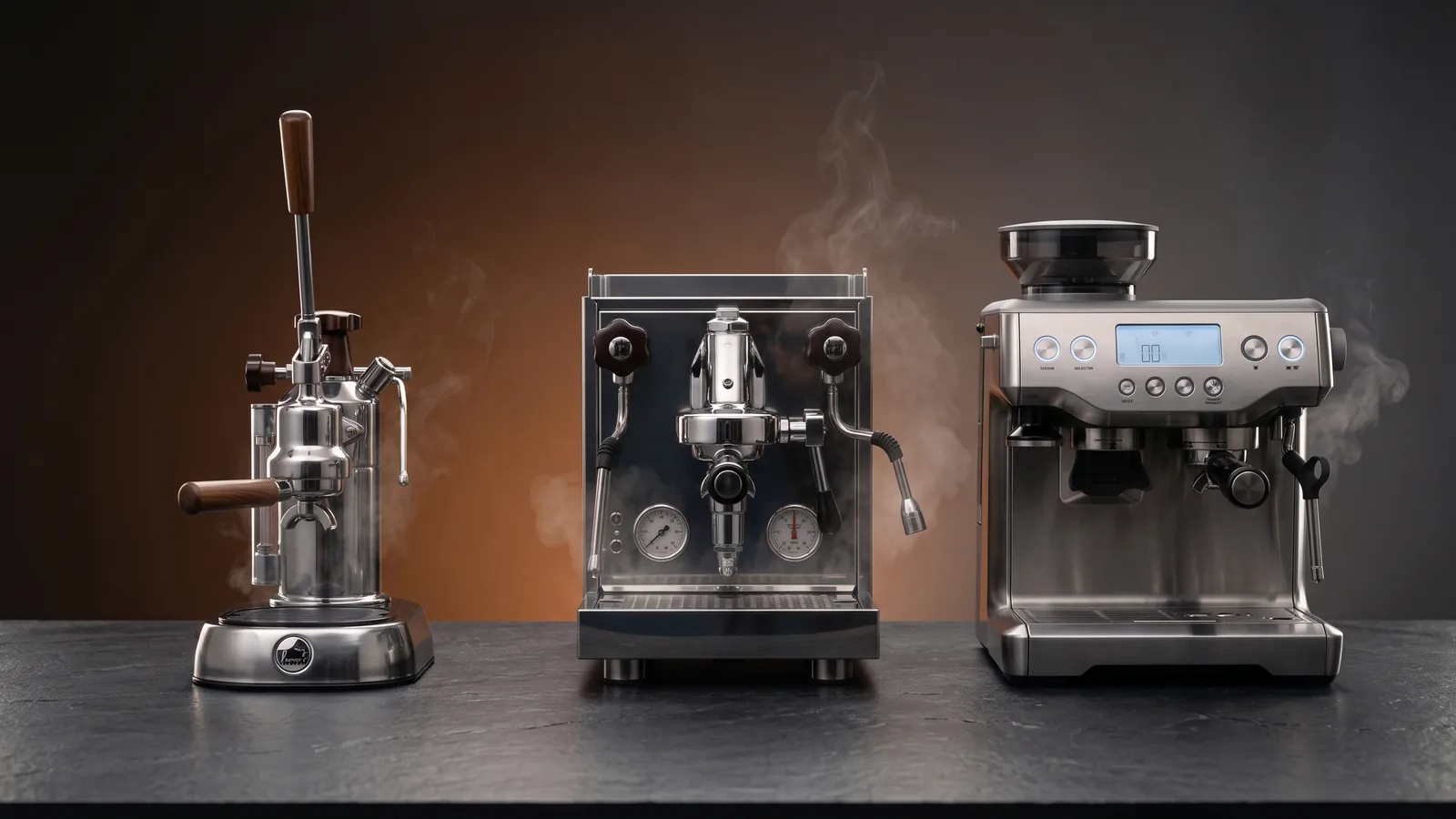
The decision that actually matters is how involved you want to be in making the shot. Espresso is not one appliance category; it is three, and they ask completely different things of you. Get this fork right and the rest of the guide is detail. Get it wrong and no amount of money fixes it — a beginner who wanted one-touch coffee will resent a machine that demands a tamp and a timer, and an enthusiast who wanted control will outgrow a one-touch box in a month.
Semi-automatic — you control the shot
The semi-automatic is the machine most people picture, and the one most home baristas settle on. It automates the pump but nothing else: you grind, dose the coffee into a portafilter, tamp it level, lock it in, and start and stop the shot yourself. It is the best quality for the money at every price tier, because you are not paying for a built-in grinder or automation — but it has a real learning curve, and it is only as good as the grinder you put in front of it.
Choose semi-automatic if you want the best cup for your budget, you are willing to practice, and you find the ritual appealing rather than annoying. See types of espresso machines explained for how the sub-types differ, and how to pull a shot of espresso for what the ritual actually involves.
Super-automatic — the machine does it
A super-automatic (also sold as “bean-to-cup” or “fully automatic”) grinds, doses, tamps, brews, and often froths milk at the press of a button. There is almost no learning curve and almost no mess. The trade is control and ultimate ceiling: you cannot dial in a shot the way a semi-automatic lets you, and the espresso, while good, rarely reaches what a skilled hand can pull on a semi-automatic in the same price range — because a chunk of that price went to the grinder and the robotics inside.
Choose super-automatic if you want good coffee fast, every day, with no fuss — and you value convenience over the last ten percent of quality. It is the right answer for far more households than espresso purists admit.
Manual lever — the enthusiast’s tool
Manual (lever) machines give you direct control over pressure by hand. They are capable of extraordinary espresso and are genuinely rewarding, but they are unforgiving, slow to learn, and the wrong starting point for almost everyone. If you are asking this question for the first time, a lever machine is not your answer yet.
| Machine type | You do | Learning curve | Quality ceiling | Best for |
|---|---|---|---|---|
| Semi-automatic | Grind, dose, tamp, start/stop, steam | Moderate | High | Best cup per dollar; people who enjoy the craft |
| Super-automatic | Press a button | Minimal | Good | Convenience, daily drinks, low fuss |
| Manual lever | Everything, by hand | Steep | Very high | Hobbyists who want total control |
The grinder question — the part most beginners get wrong
Here is the single most important thing in this guide, and the one most new buyers underestimate: for a semi-automatic, the grinder matters more than the machine.
Espresso lives or dies on the grind. It needs coffee ground fine, evenly, and consistently enough to create resistance against the pump — that resistance is what produces pressure, extraction, and crema. A blade grinder cannot do it; it chops unevenly and the shot runs sour and fast. Pre-ground coffee is stale within minutes of grinding and is rarely ground fine enough for espresso anyway. Only a burr grinder — ideally one built for espresso’s fine range — gets there.
This creates two honest paths, and one trap:
- Semi-automatic + a dedicated burr grinder. The standard setup. Budget for the grinder as seriously as the machine; a capable machine with a cheap grinder is throttled by the grinder, every single shot.
- Super-automatic with a good grinder built in. The grinder is inside the price, which is part of why super-automatics cost more. This is a legitimate way to avoid buying a separate grinder.
- The trap: a good semi-automatic paired with a cheap grinder. This is the most common and most disappointing mistake in home espresso. The machine gets blamed; the grinder was the problem.
If you are going the semi-automatic route, plan for a real burr grinder from the start — see our coffee grinder guides for the espresso-capable options.
Pressurized vs non-pressurized portafilter — forgiveness vs ceiling
The portafilter is the handled basket that holds the coffee, and it comes in two kinds that change how forgiving the machine is.
A pressurized (dual-wall) portafilter has a restricting valve that creates crema artificially, which means it can produce a decent-looking shot even with an imperfect grind or a supermarket pre-ground. It is forgiving — good for beginners and for anyone who will not grind fresh — but it caps the quality: you cannot taste the difference a better grind or technique would make, because the valve is doing the work.
A non-pressurized (single-wall) portafilter does nothing artificial; the coffee has to be right. It is less forgiving and demands a good grinder, but its ceiling is far higher, and it is what you want if you plan to improve. Many machines ship with both baskets so you can start forgiving and graduate. This choice is covered in depth in pressurized vs non-pressurized portafilter.
Bar pressure — the number on the box that does not matter
Boxes advertise 15 bars, 19 bars, sometimes more, and buyers reasonably assume higher is better. It is not. Nine bars at the coffee puck is the espresso standard, and essentially every real machine can reach it. The 15 or 19 on the box is the pump’s unloaded maximum, not what the coffee experiences during extraction — the puck and the grind create the resistance that brings it down to nine.
A higher advertised number does not make better espresso and should not sway the decision. What produces good pressure is a grind fine enough to create resistance, not a bigger pump. Treat the bar figure as marketing and spend your attention on temperature stability and the grinder instead.
Boilers and temperature — the quiet thing that separates tiers
Water temperature stability is one of the biggest differences between a cheap machine and a serious one, and it is invisible on a spec sheet unless you know to look.
- Single boiler. One boiler heats water for brewing and, separately, for steam, so you cannot brew and steam at the same time — you pull the shot, then wait for the boiler to reach steam temperature. Fine for one or two drinks at a time; slower for milk drinks.
- Heat exchanger (HX). A single boiler with a clever circuit that lets you brew and steam simultaneously. A meaningful convenience step up, common in the mid-to-upper range.
- Dual boiler. Two separate boilers, one for brewing and one for steam, each independently and precisely controlled. The most stable and the most capable for back-to-back milk drinks — and the most expensive.
Alongside the boiler, look for PID temperature control: an electronic controller that holds the brew temperature to within a degree or two shot after shot. PID is the difference between espresso that tastes the same every morning and espresso that drifts. On a semi-automatic, a PID is one of the most worthwhile features you can pay for.
The steam wand and milk drinks — weight this by how you actually drink
If most of what you make will be lattes, flat whites, and cappuccinos, the milk system may matter more than the espresso side, and buyers who ignore it regret it.
- Manual steam wand. You texture the milk yourself. It produces genuine cafe-quality microfoam and gives you full control, but it takes practice, and the quality of the wand (number of holes, steam power) varies a lot.
- Automatic / panarello frother. A wand with an attachment that froths with less skill. Easier, more consistent, but the foam is airier and less silky than hand-textured microfoam.
- One-touch milk system. Found on many super-automatics: the machine draws, heats, and froths milk into the cup automatically. The easiest path to a consistent milk drink, at some cost to texture and control.
Be honest about which of these you want to operate every morning. A manual wand you never master is worse than an automatic frother you actually use.
Build, size, and the counter reality
The specs that do not show up in the coffee still shape whether you keep using the machine:
- Portafilter size. A 58mm portafilter is the commercial standard and means wide access to baskets, tampers, and accessories. Smaller or proprietary sizes limit your options and your upgrade path.
- Footprint and height. Espresso machines are deeper and taller than people expect, and many will not fit under a standard upper cabinet with the lid open or the hopper on. Measure before you buy.
- Water tank vs plumbed. Nearly all home machines use a removable tank; check the size against how many drinks you make between refills.
- Warm-up time. A machine that needs fifteen to thirty minutes to reach temperature changes your morning. Faster-heating machines (thermoblock, or smaller boilers) trade some stability for speed; know which you are getting.
Budget tiers — what you actually get at each level
Prices move, so treat these as market bands rather than exact figures, and remember a semi-automatic’s budget has to include the grinder.
- Under ~$300 (machine only). Entry semi-automatics, usually with a pressurized basket and a basic single boiler. Capable of a real step up from drip coffee once paired with a decent grinder, but the ceiling is modest.
- ~$300–$700 (machine) + ~$150+ grinder. The sweet spot for semi-automatics, where quality stops being limited by the equipment — PID, a proper steam wand, 58mm, non-pressurized baskets. This is where most serious home setups live.
- ~$600–$1,500. Strong super-automatics (grinder and milk system included) and higher-end semi-automatics with heat exchangers or dual boilers.
- ~$1,500+. Dual-boiler enthusiast machines and premium super-automatics. Diminishing returns for most people, real gains for the committed.
The honest headline: the realistic entry point for espresso that genuinely beats a cafe is a capable machine plus a real grinder, which together land in the mid-hundreds — not the sub-$100 machines that fill the listings.
What owners wish they’d known
We analyzed verified owner reviews across 17 of the most popular espresso machines to see what actually goes wrong — the full findings are in The Espresso Machine Complaint Report. The pattern is clear, and it is not about shot quality or the specs on the box — the complaints that most damage a machine’s rating are about reliability:
- Durability is the real risk. Across the reviews, durability complaints drag ratings harder than any other issue, with “it stopped working” close behind. A machine that fails in its second year earns the angriest reviews on the page — so a model’s track record for lasting matters more than its feature list.
- Leaking is the most common specific gripe. Water leaks — from the tank, the group head, or the portafilter — are the single most frequent complaint theme. A machine’s reputation for staying sealed is worth weighting heavily.
- Cleaning, descaling, and clogging are underestimated. Ease of cleaning and jamming or clogging both rank high among the complaints; neglected machines fail early. Espresso machines need regular backflushing and descaling — see how to clean an espresso machine.
- The grinder still decides the cup. Owners rarely name the grinder in their complaints — but the sour, fast-running shots they blame on the machine almost always trace back to it. Budget for a real burr grinder from the start.
- Ease of use is what owners praise most. When a machine is reliable, simplicity is what makes owners recommend it — the most-praised trait across the reviews, well ahead of any single feature. If you want a machine you will actually keep using, optimize for reliability and ease over spec-sheet extras.
And two things buyers consistently underestimate before they start: the milk-steaming learning curve (texturing milk by hand takes weeks, not minutes), and the counter reality — footprint, warm-up wait, and daily cleanup quietly decide whether a machine stays out or goes in a cupboard.
The decision in one table
| If you are… | Choose | Prioritize | And don’t overpay for |
|---|---|---|---|
| New, want good coffee fast, low fuss | Super-automatic | Grinder quality, one-touch milk | A separate grinder you won’t need |
| Willing to learn, want the best cup per dollar | Semi-automatic | A real burr grinder, PID, 58mm | Bar-pressure numbers |
| A latte-first household | Either, milk-system-led | Steam wand or one-touch milk quality | An elaborate shot setup you won’t use |
| Chasing the ceiling, enjoy the craft | Semi-automatic (HX/dual boiler) | Temperature stability, grinder | Automation you’ll bypass |
Match it to how you drink
Once you know your type, the money pages narrow it to specific machines:
- New to espresso? Start with the best espresso machines for beginners.
- Want the machine and grinder in one box? Look at machines with a built-in grinder.
- Want one-touch convenience? Look at automatic and super-automatic machines.
- Want full control and the best cup per dollar? Look at manual and semi-automatic machines.
- Comparing the jump in price? Read premium vs budget espresso machine before you decide how far up the range to go.
And if you are still deciding whether espresso is even the right machine for your kitchen, espresso machine vs coffee maker is the place to start.
The bottom line
An espresso machine is not a single purchase; it is a system — the machine, the grinder, and your own patience. The buyers who are happy a year later are the ones who matched the machine to how involved they wanted to be, budgeted for the grinder as seriously as the machine, and ignored the marketing number on the box. Decide the one thing that matters first — how much you want to control versus automate — and every other choice in this guide falls into place.