Coffee Brewing Terms, Explained: A Plain-Language Glossary
Noolaguide Editorial·Last updated
Disclosure: As an Amazon Associate, Noolaguide earns from qualifying purchases — we may earn a commission when you buy through links on this page, at no extra cost to you. Our recommendations are editorially independent. How we make money.
A plain-language glossary of the coffee terms that actually change your cup: extraction, TDS, fines and boulders, bloom, degassing, channeling, drawdown, retention, and more. Each one defined in a sentence, with why it matters — so the vocabulary on every other coffee page makes sense.
Good coffee has a vocabulary, and most of it points at one idea: getting water to pull flavor out of the grounds evenly. Here are the terms worth knowing, grouped by where they come up.
Extraction and strength
Extraction — water dissolving flavor out of the grounds. Too little tastes sour and thin; too much tastes bitter; balanced is the goal. The master concept behind everything else. See why grind size changes extraction.
Under-extraction — not enough flavor pulled out: sour, salty, weak. Usually too coarse a grind, too short a brew, or water too cool.
Over-extraction — too much pulled out: bitter, harsh, drying. Usually too fine a grind, too long a brew, or water too hot.
Strength — how concentrated the cup is (how much dissolved coffee per unit of water). Set mostly by the coffee-to-water ratio. Not the same as extraction: a cup can be strong and under-extracted.
TDS (total dissolved solids) — the percentage of the brew that’s dissolved coffee, a precise measure of strength. Balanced brewed coffee is roughly 1.15–1.45%.
Grind
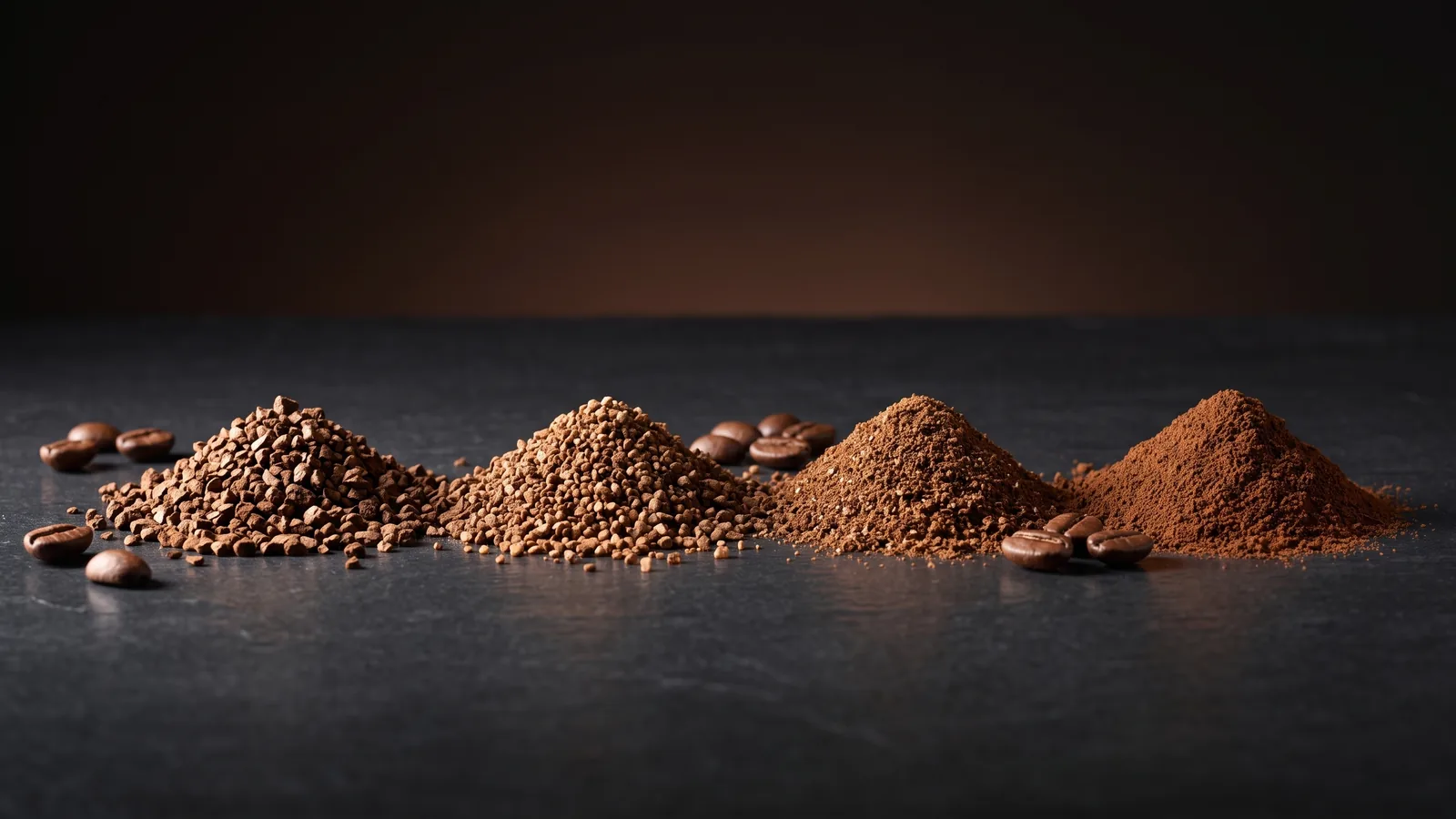
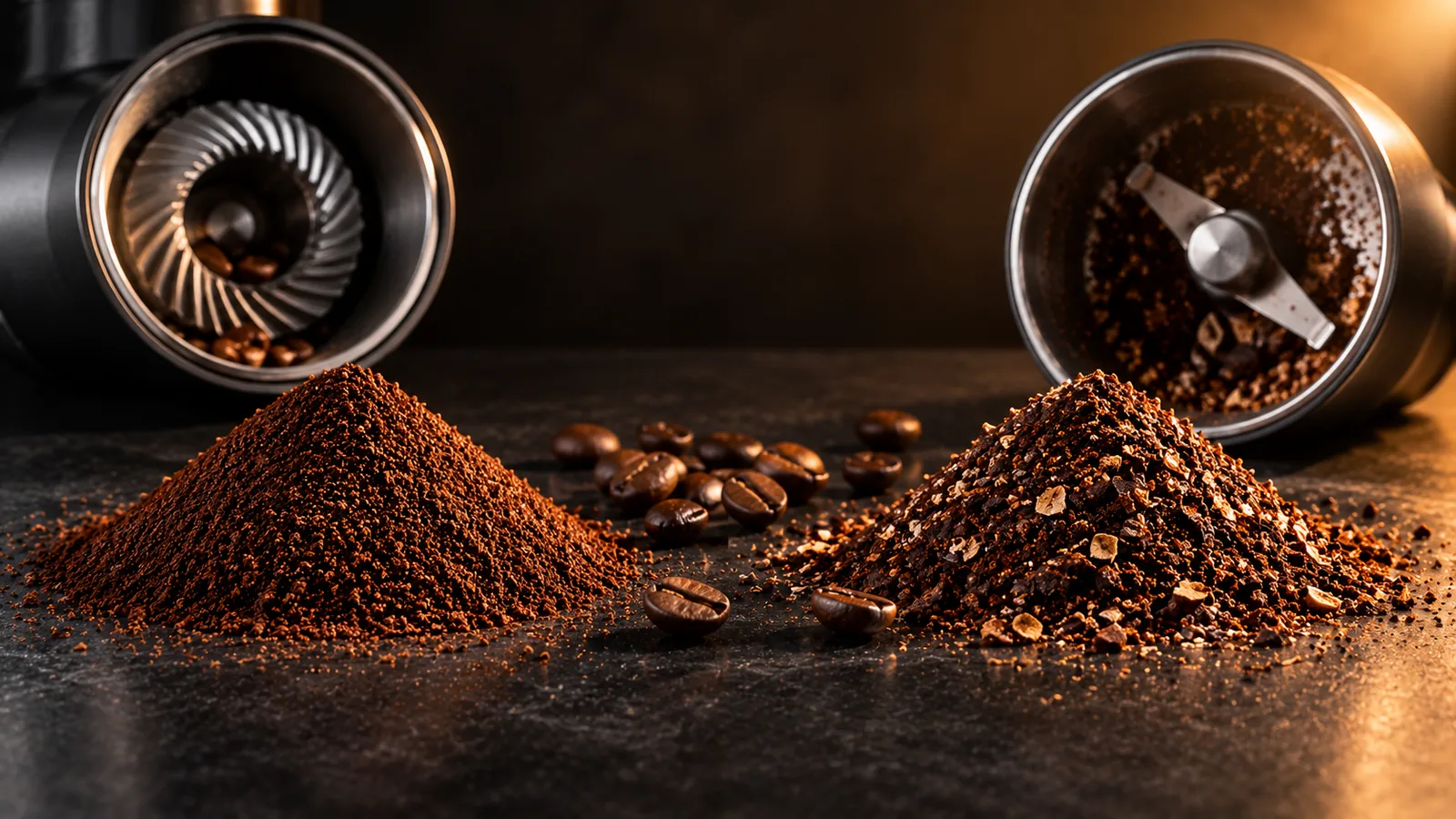
Particle distribution — the spread of grind sizes in a batch. A tight, uniform distribution extracts evenly; a wide one tastes muddy. This is the whole case for a burr grinder over a blade.
Fines — the smallest particles, coffee dust. A few are normal; too many over-extract (bitterness) and clog filters.
Boulders — oversized chunks. Water can’t reach their centers, so they under-extract and add sourness.
Grind retention — coffee left stuck inside the grinder after grinding. High retention means stale grounds mixing into your next fresh dose.
Burr alignment — how parallel and true a grinder’s two burrs sit. Good alignment gives a tighter particle distribution; poor alignment widens it.
Brewing
Bloom — the foaming when hot water first hits fresh grounds, as roasting CO₂ escapes. A short “bloom pour” and pause lets the gas out so the main pour saturates evenly. Central to pour-over.
Degassing — fresh-roasted beans releasing CO₂ over days after roasting. Very fresh coffee can brew unevenly because the gas pushes water away; a few days’ rest helps.
Agitation / turbulence — stirring or pouring force that moves the grounds around, which speeds and evens extraction. Too much can over-extract; too little leaves dry pockets.
Channeling — water rushing through one path in the coffee bed instead of soaking it evenly, so part over-extracts and part under-extracts. Fought with an even grind and even wetting.
Drawdown — the time it takes the last water to drain through a pour-over bed. A very slow drawdown often means too fine a grind or clogging fines; very fast means too coarse.
Immersion vs. percolation — the two ways to brew. Immersion steeps grounds in a body of water (French press, cold brew); percolation flows water through a bed (pour-over, drip).
Espresso terms (in brief)
Dose / yield / ratio — the grams of grounds in (dose), grams of liquid out (yield), and their ratio (commonly around 1:2). How espresso is portioned, instead of by the pot.
Pre-infusion — a gentle wetting of the puck before full pressure, which reduces channeling.
Crema — the reddish-brown foam on a fresh espresso shot, from emulsified oils and CO₂.
Why the vocabulary is worth it
None of these terms are decoration — each one names a lever you can actually pull. Knowing that “muddy” coffee is really fines over-extracting from a wide particle distribution tells you the fix (a better, more even grind), where “my coffee tastes bad” doesn’t. Start with the two that move the cup most: grind size and the coffee-to-water ratio. If grind consistency is the lever you want to improve, our best burr coffee grinders guide is the place to start.
Frequently asked questions
Extraction is the process of water dissolving flavor compounds out of ground coffee. It's the heart of brewing: too little extraction (under-extraction) leaves the coffee sour, thin, and salty; too much (over-extraction) makes it bitter and harsh; the balanced middle is where coffee tastes sweet and complete. Grind size, water temperature, brew time, and the coffee-to-water ratio are the levers that control how much you extract.
Fines are the smallest particles a grinder produces — coffee dust — and boulders are the largest, oversized chunks. Every grind contains a spread of sizes, but a good burr grinder keeps that spread tight, with few fines and few boulders. It matters because fines over-extract (they're tiny, so water strips them fast, adding bitterness and sometimes clogging filters) while boulders under-extract (water can't reach their centers, adding sourness). A blade grinder makes far more of both, which is why its coffee tastes muddy and unbalanced.
The bloom is the burst of foaming and bubbling that happens when hot water first hits fresh coffee grounds — carbon dioxide trapped in the beans from roasting escapes all at once. Pouring a small amount of water to wet the grounds and pausing 30–45 seconds (the 'bloom pour') lets that gas escape before the main pour, so water can then saturate the coffee evenly instead of being pushed away by gas. Fresher coffee blooms more; stale coffee barely blooms at all.
TDS stands for total dissolved solids — the percentage of your brewed coffee that is actually dissolved coffee rather than water. It's a precise way to measure strength: most balanced brewed coffee lands around 1.15–1.45% TDS, while espresso is far higher. You don't need to measure TDS to make good coffee (taste works), but the term explains why 'strength' and 'extraction' aren't the same thing — strength is how concentrated the cup is, extraction is how much flavor you pulled from the grounds.
Channeling is when water finds a path of least resistance through the coffee bed and rushes through that channel instead of soaking the grounds evenly. The coffee along the channel over-extracts while the rest under-extracts, so the cup tastes both bitter and weak at once. It's most talked about in espresso (from uneven puck prep) but happens in pour-over too, from an uneven pour or an uneven grind. An even grind and gentle, even wetting are the main defenses.