The rule that filters every oat milk machine
Before picking a machine, understand one constraint: oat milk cannot be made with heat.
Oat starch — a mix of amylose and amylopectin — gelatinizes at approximately 55–65°C. Heat activates the starch, absorbs water, and produces the thick, slimy consistency that makes bad oat milk undrinkable. Every machine that heats its contents during processing is the wrong tool for oat milk, regardless of whether it claims oat milk as a supported function.
This is why dedicated soy milk makers — which heat to 100°C to deactivate trypsin inhibitors — are excluded from this roundup. It is also why machines like the ChefWave Milkmade and Kidisle are included only if you use their cold or oat-specific program, not their heated soy cycle.
The machines below either have no heating element at all (the Nama M1, Almond Cow) or have a cold extraction mode that keeps the contents below the starch gelatinization threshold.

Nama M1 Plant Milk Maker
Designed specifically for cold-press grain, nut, and seed milks — which makes it the best oat milk machine in this roundup. Patent-pending cold-press technology blends and strains in one container, producing barista-quality oat milk with notably less starch extraction than blade-based cold machines.
Prime Day Amazon Prime Big Deal Days is on — a good time to check the live price.
Check current price on AmazonWhat buyers praise
- Cold-press motor minimizes starch release — the smoothest oat milk in this roundup
- Blends and strains in one container — no separate straining step
- Works with oats, nuts, and seeds with no machine swaps
- 15-year warranty — the longest in this category
- Dry pulp output — reusable for baking, less waste
What buyers flag
- Premium price — the most expensive machine in this roundup
- Mixing is the one quality a minority of owners penalize (occasional motor/blend reports)
- Cold-press only — does not make soy milk (requires boiling, excludes this machine)
- No heated programs — buyers who also want soy milk need a second machine
Why the Nama M1 leads for oat milk specifically
Most milk makers use a high-speed blade to break down ingredients. The problem with oat milk is that aggressive blending — even without heat — releases more starch into the liquid, increasing sliminess. The Nama M1’s cold-press motor operates differently: it presses and separates rather than shearing, which produces less starch extraction and a cleaner oat milk texture.
Reviewers consistently describe Nama M1 oat milk as the smoothest they’ve made at home, with texture that approaches commercial oat milk rather than the grainier output from blade machines. The one-container design — blend and strain in the same vessel — means you do not have to pour through a separate bag, which further reduces agitation of the extracted liquid.
The cold-press exclusion for soy milk is the main trade-off. Soy milk requires 100°C heating to deactivate trypsin inhibitors; the Nama M1 cannot provide this. If you make both oat and soy milk regularly, you need the Nama M1 for oat milk and a heated machine for soy — or choose the ChefWave, which handles both in one machine at the cost of some oat milk quality.

Almond Cow Nut Milk Maker Machine
Cold extraction is the only function — no heating element, no heated programs. This makes it structurally the safest oat milk machine: there is no heated mode to accidentally run. Makes 5–6 cups per batch, stainless steel interior, no straining needed. The most proven cold-extraction machine in buyer volume.
Prime Day Amazon Prime Big Deal Days is on — a good time to check the live price.
Check current price on AmazonWhat buyers praise
- No heating element — physically cannot produce slimy heated oat milk
- 5–6 cups per batch — largest output in this roundup
- Stainless steel interior — no plastic contact with liquid
- No straining bag needed — built-in pulp separation
- 60-second cycle — the fastest machine in this comparison
What buyers flag
- Cold extraction only — cannot make soy milk or heated grain milks
- Higher price than budget cold-extraction alternatives
- No delay start or keep warm functions (not applicable to cold milk, but worth noting)
- Larger footprint than single-serving or compact machines
What makes the Almond Cow the safest oat milk choice
There is a meaningful distinction between machines that can do cold extraction and machines that only do cold extraction. The Almond Cow belongs to the second category: it has no heating element and no heated programs. When you run oat milk through it, the only available processing mode is cold.
This matters because multi-use machines with heated and cold programs require the buyer to select the correct cycle. Running oat milk through a heated program by mistake — common in households where different people use the machine — produces the slimy result cold extraction is meant to prevent. With the Almond Cow, this error is structurally impossible.
The 5–6 cup (40–48oz) capacity is the largest in this roundup and makes it the appropriate choice for families or households that consume oat milk daily. At 60 seconds per cycle, batch production is fast enough to run multiple iterations without it becoming a project.
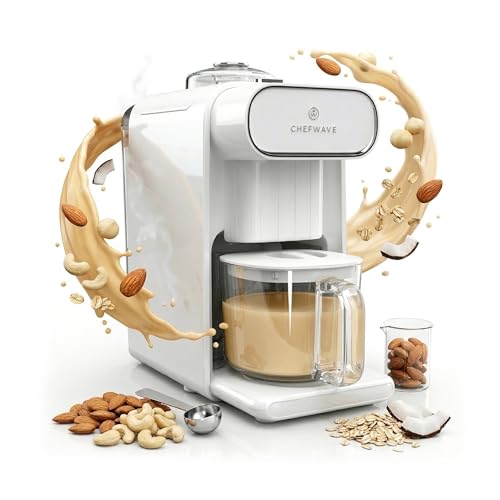
ChefWave Milkmade 6-in-1
The best multi-milk machine if you make both oat milk and soy milk or almond milk from one appliance. Use the dedicated oat or cold-extraction program — not the soy/hot program. Its controlled-heat oat setting avoids the sliminess of cold-blended oat milk, and cleaning is the quality its owners reward it for most.
Prime Day Amazon Prime Big Deal Days is on — a good time to check the live price.
Check current price on AmazonWhat buyers praise
- Controlled-heat oat program avoids cold-blended sliminess
- Cleaning is its standout strength — owners reward it here above the norm
- Six programs — also soy, almond, cashew, coconut in one machine
- Glass pitcher — no plastic milk contact or storage
- No soaking required for any program
What buyers flag
- Must use the correct program — running oat milk through the heated soy cycle produces slimy milk
- Durability is the quality its owners penalize most
- Moderate capacity for a family household
- Oat milk quality is good but not as refined as the Nama M1's cold-press output
ChefWave for oat milk: the right program is everything
The ChefWave Milkmade is the most versatile general-purpose plant milk machine here, and cleaning is the quality its owners reward it for most. It is included in this oat milk roundup because it has a dedicated oat program that processes oat milk with controlled heat — avoiding the sliminess cold-blended oat milk can develop.
The caveat is user-level: the machine has multiple programs including a heated soy program at 100°C. If you run oat milk through the soy cycle, you will produce slimy oat milk. The machine’s labeling and instruction manual specify which program to use for oat milk; follow this exactly.
Why include it here: for buyers who want one machine that makes both oat milk and soy milk — the two most commonly made plant milks — the ChefWave is the practical answer. The dedicated oat program works correctly; the soy program works correctly. You do not need a second machine for different milk types.
Also worth considering
AlfaBot N1 — cold-extraction focus, compact
Cold-extraction focused · 20oz
The AlfaBot N1 is designed primarily for cold-extraction nut and grain milks, and its compact 20oz size suits single-person households making oat milk daily — roughly two glasses per batch. One caveat worth reading before buying: across AlfaBot’s reviews, the complaint that recurs most is a plastic or burning smell during heated use, and there are some early-failure reports — so buy with an easy return window. Full AlfaBot review and the smell caveat.
Kidisle 32oz — budget oat milk on cold cycle
Budget 8-in-1 · hot + cold programs
The Kidisle 32oz 8-in-1 makes acceptable oat milk on its cold extraction cycle, and it is the strongest-rated budget machine in this cluster — owners reward it for ease of use and value, with the honest caveat of a quality-control lottery. The caveat for oat milk specifically: the Kidisle has both hot and cold programs. Use the cold cycle for oat milk; the machine heats on its soy cycle, which would gelatinize oat starch. Full Kidisle review.
What we excluded — and why
Heated soy milk makers (SoyaJoy G5, Tribest Soyabella soy mode): these machines are engineered to heat to 100°C for soy milk safety. Running oat milk through them produces gelatinized starch. They belong in the soy milk maker roundup, not here.
Machines with only a heated program: several budget machines on Amazon list oat milk as a supported function but operate via a single heated program. If the machine heats by default, it cannot produce non-slimy oat milk regardless of the label.
High-speed blenders (Vitamix, Blendtec): can make oat milk but require a separate straining step and very short blend times to avoid starch extraction. Over-blending — even 5–10 extra seconds — produces noticeably slimy results. A dedicated milk maker is meaningfully more consistent for oat milk.
Getting the best oat milk from any machine
The ratio
1 cup rolled oats : 4 cups cold water is the standard starting point. This produces milk comparable in consistency to commercial oat milk. Adjust:
- Creamier (barista-style): 1 cup oats to 3 cups water
- Lighter (lower-calorie): 1 cup oats to 5 cups water
Use rolled oats (old-fashioned oats). Quick oats are more processed and release more starch. Steel-cut oats are too hard for most cold-extraction motors and produce grainier milk.
Do not soak
Unlike almonds and cashews, oats should not be soaked before blending. Pre-soaking hydrates and softens the oat starch, making it release more readily during blending and increasing sliminess. Use dry rolled oats directly from the bag.
Water temperature
Use cold or room-temperature water. Warm water — even water that is not hot — accelerates starch gelatinization. If your kitchen is warm, chill the water briefly before use.
Straining matters
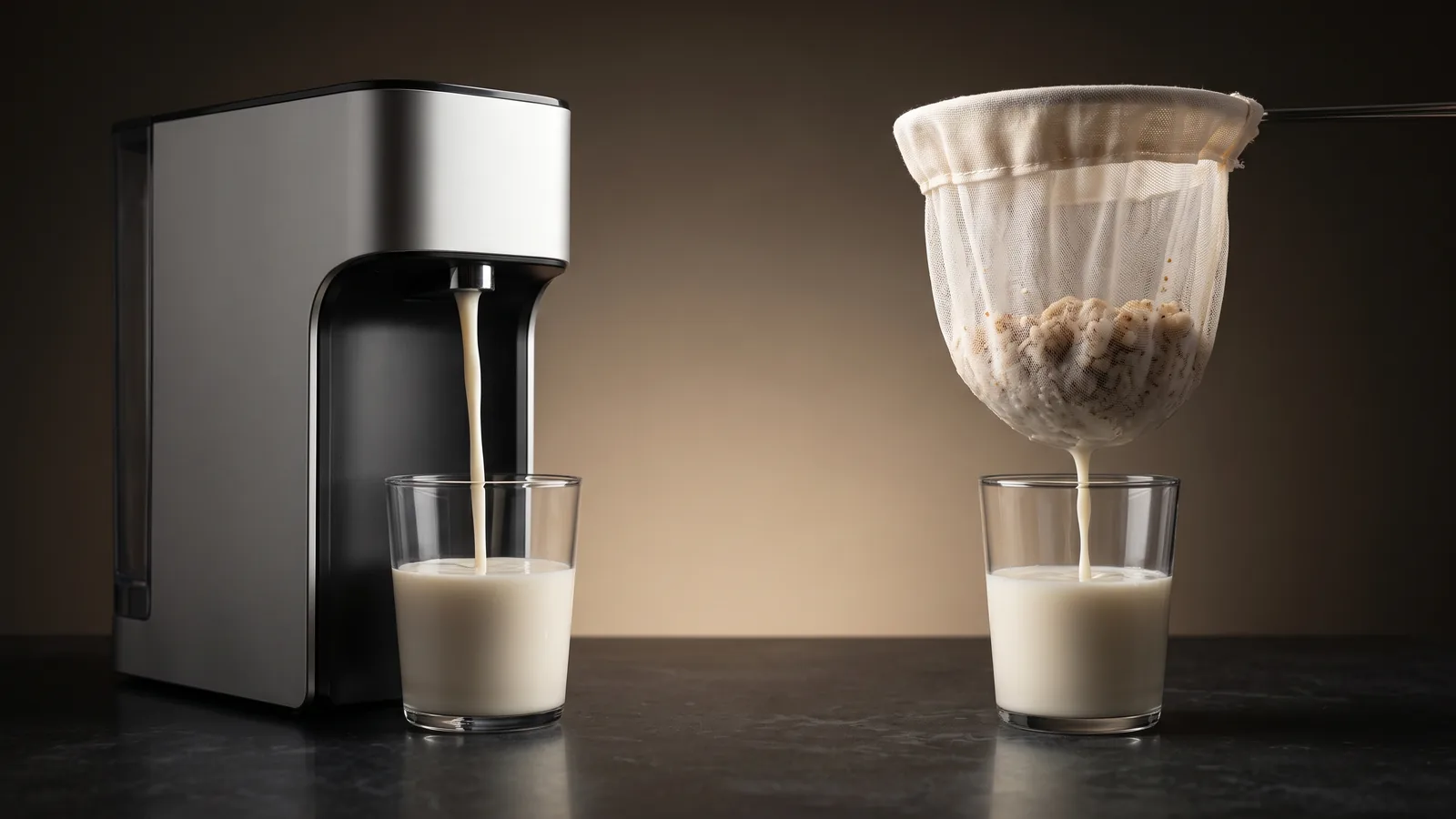
Even with machines that include built-in straining, a second pass through a fine-mesh cloth or dedicated milk bag improves texture and removes residual starch particles. This extra step is optional but produces cleaner oat milk, particularly if your machine is blade-based rather than cold-press.
Store cold, shake before use
Freshly made oat milk separates during refrigerated storage — starch settles at the bottom. This is normal and does not indicate a problem with the batch. Shake or stir before each use. Freshness: 3–4 days refrigerated. Do not freeze; thawing destabilizes the emulsion and produces grainy texture.
Full ratios and instructions for every milk type. · The best plant-based milk makers