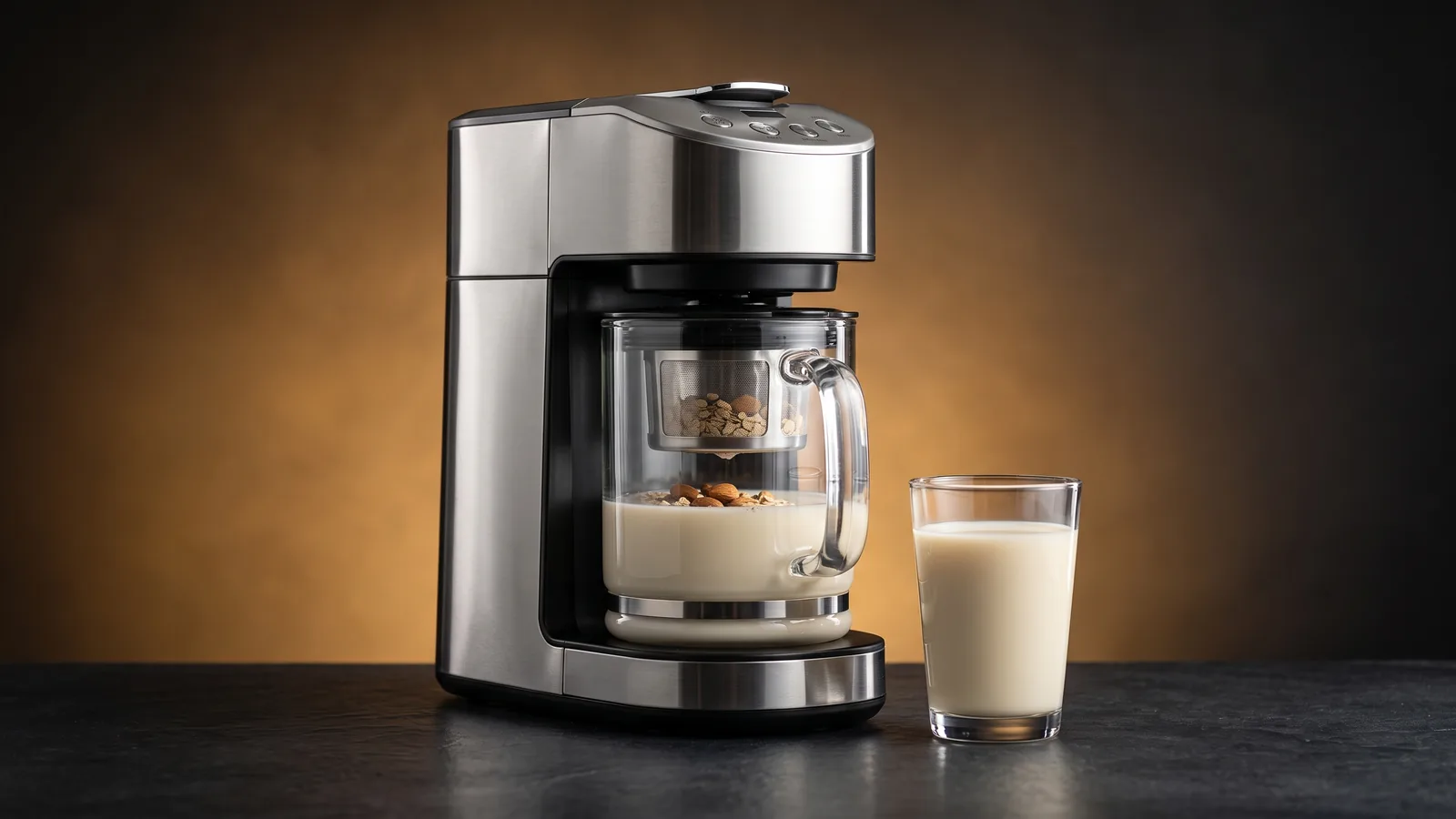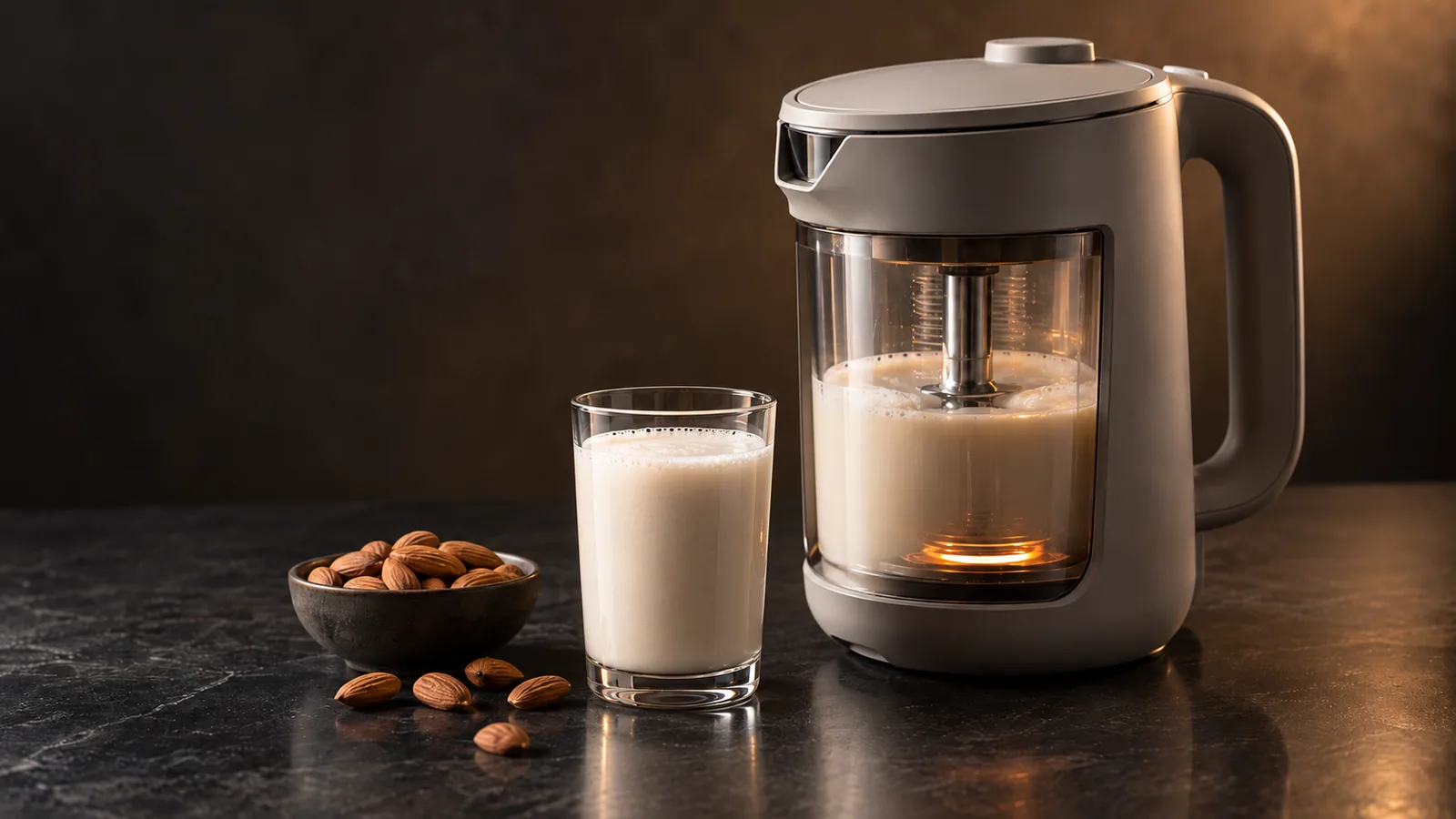
The two extraction methods
Every plant-based milk maker does the same job — extract liquid from nuts, seeds, or grains — but the mechanism splits cleanly into two approaches. Understanding which one a machine uses is the most important thing to know before buying.
Heated extraction
Most dedicated plant-based milk makers on the market heat the liquid during or after blending. The typical cycle:
- Soaked nuts (or unsoaked, depending on machine) are added to the carafe with water
- The blade spins at high speed, breaking down the nut or grain
- The heating element raises the liquid temperature — commonly to 80–100°C
- A filtration step strains the pulp, either through a built-in mesh or by pouring through a bag
What heating does: heat loosens cell walls and dissolves more solids into the liquid, producing a slightly creamier, more neutral-tasting result. For soy milk specifically, heating is not optional — raw soy contains trypsin inhibitors that cause digestive discomfort, and only sustained heat above 80°C deactivates them reliably.
The plastic-smell problem: the dominant complaint about budget heated machines is an off-taste or plastic smell transferred to the milk during heating. This concentrates in machines where polypropylene or other plastic components contact liquid at temperature. It is not a defect in the mechanical sense — the machine works — but it makes the milk taste wrong. Stainless-interior designs largely avoid the problem; plastic-interior designs are where the complaint clusters in buyer reviews.
Where heated extraction is the right choice:
- Soy milk (heating is required for food safety)
- Buyers who prefer a slightly creamier, more neutral taste
- Cold-climate households where warm milk straight from the machine is appealing
Cold extraction
Cold-extraction machines blend without activating a heating element. The Nama M1 uses a slow-masticating auger mechanism. Most other “cold” options are simply heated machines with a cold-blend cycle that disables the heating element.
The cycle is simpler: nuts and water go in, the blade blends, and liquid is filtered. No heat is applied.
What you get: a lighter, fresher-tasting milk — the flavor profile is closer to what a high-powered blender produces. Lower extraction efficiency means slightly less solid material in the same quantity of milk, so the result is often thinner than a heated equivalent from the same nut-to-water ratio. Adjusting the ratio up (more nuts per cup of water) compensates.
The oat milk case: oat milk should always be made cold. Heating oat milk causes the starches to gelatinize, producing a thick, gluey texture that is unpleasant to drink and difficult to strain. If a heated machine does not include a cold-blend cycle and oat milk is a priority use, it is the wrong machine.
Where cold extraction is the right choice:
- Almond, cashew, and hemp milk where fresh taste is preferred
- Oat milk (cold only)
- Buyers concerned about plastic off-taste from heated designs
- Households where room-temperature or cold milk is preferred
The self-cleaning cycle: what the mechanism actually is
Both machine types typically include a self-cleaning program. The mechanism: the machine runs a short high-speed spin cycle with warm water, rinsing the blade assembly and carafe walls.
This removes surface residue and works well as a post-batch rinse. It does not:
- Remove nut oil that has adhered to the filter mesh
- Clean the blade bearing or gasket
- Replace a weekly brush clean
The self-cleaning marketing overstates what the program does. It is a convenience rinse, not a substitute for manual cleaning.
Read the full guide: How to Clean a Nut Milk Maker
Summary: mechanism by use case
| Use case | Mechanism needed | Why |
|---|---|---|
| Soy milk | Heated | Heating required to deactivate trypsin inhibitors |
| Oat milk | Cold only | Heat causes starch gelatinization → slimy texture |
| Almond milk | Either works | Cold produces fresher taste; heated is slightly creamier |
| Cashew milk | Either works | Cashews are soft; cold extraction is fully effective |
| Hemp milk | Either works | Hemp seeds blend easily; heat adds nothing meaningful |
How to read a machine’s spec sheet for mechanism
Manufacturers do not always state clearly whether a machine heats. Look for:
- “Heating element” or “heating cycle” in the spec list — the machine heats
- “Cold press” or “cold extraction” in the product name or description — the machine does not heat (or has a cold option)
- “Self-heating” or “auto heat” — heats automatically as part of the cycle
- Absence of any mention — assume heated if the machine has multiple programs; assume cold-blend if it is a simple single-function blender attachment
If the spec sheet does not specify, check the Q&A or verified-buyer reviews. The presence or absence of heating is the first thing buyers figure out, and the answer is almost always in the reviews.
Next: How to choose a plant-based milk maker based on what you just learned
Already know what you need? See the best plant-based milk makers for our ranked picks by use case.
Our overall pick — ChefWave Milkmade. The most versatile machine and the easiest to clean, covering both cold nut/oat milks and heated soy:

ChefWave Milkmade 6-in-1 Nut Milk Maker
The most versatile machine and the easiest to clean — the best pick for most buyers. Six programs cover cold nut milks plus heated soy, oat, and rice, so it replaces what would otherwise take two machines, and cleaning is the quality its owners reward it for most. The honest trade-off is durability, the quality it is penalized for most; inspect on delivery, as a subset report units arriving used.
Prime Day Amazon Prime Big Deal Days is on — a good time to check the live price.
Check current price on AmazonWhat buyers praise
- Six programs including heated soy and oat — one machine for every milk
- Cleaning is its standout strength — rewarded above the category norm
- Glass pitcher — taste-neutral and dishwasher-safe
- Controlled-heat oat program avoids cold-blended sliminess
What buyers flag
- Durability is the quality owners penalize most
- A subset report units arriving open-box or used — inspect on delivery
- A few note an off-smell on the soy cycle specifically
- Higher price than budget machines