What a food processor does well
Chopping and mincing
The S-blade processes solid ingredients into uniform pieces through rapid rotary chopping. This is the most versatile and most commonly used capability.
Onions and alliums. A halved onion processes to a uniform dice in 5–8 pulses. Garlic cloves mince to a paste in 3–5 seconds. For recipes requiring large quantities of onion or garlic (soups, stocks, sauces), this is dramatically faster than hand-cutting.
Herbs. A bunch of parsley or cilantro stems removed, leaves processed to a fine chop in 5 seconds. Equivalent hand-chopping takes 3–5 minutes.
Nuts. Coarsely chopped walnuts, finely processed almond flour, or anything in between — controlled by pulse duration and frequency. 3 long pulses produces coarse pieces; 10 quick pulses produces a powder.
Cooked meat. Pulled pork and shredded chicken can be processed in brief pulses. 3–4 one-second pulses produces shreds without turning the meat to paste.
Slicing and shredding (with disc attachments)
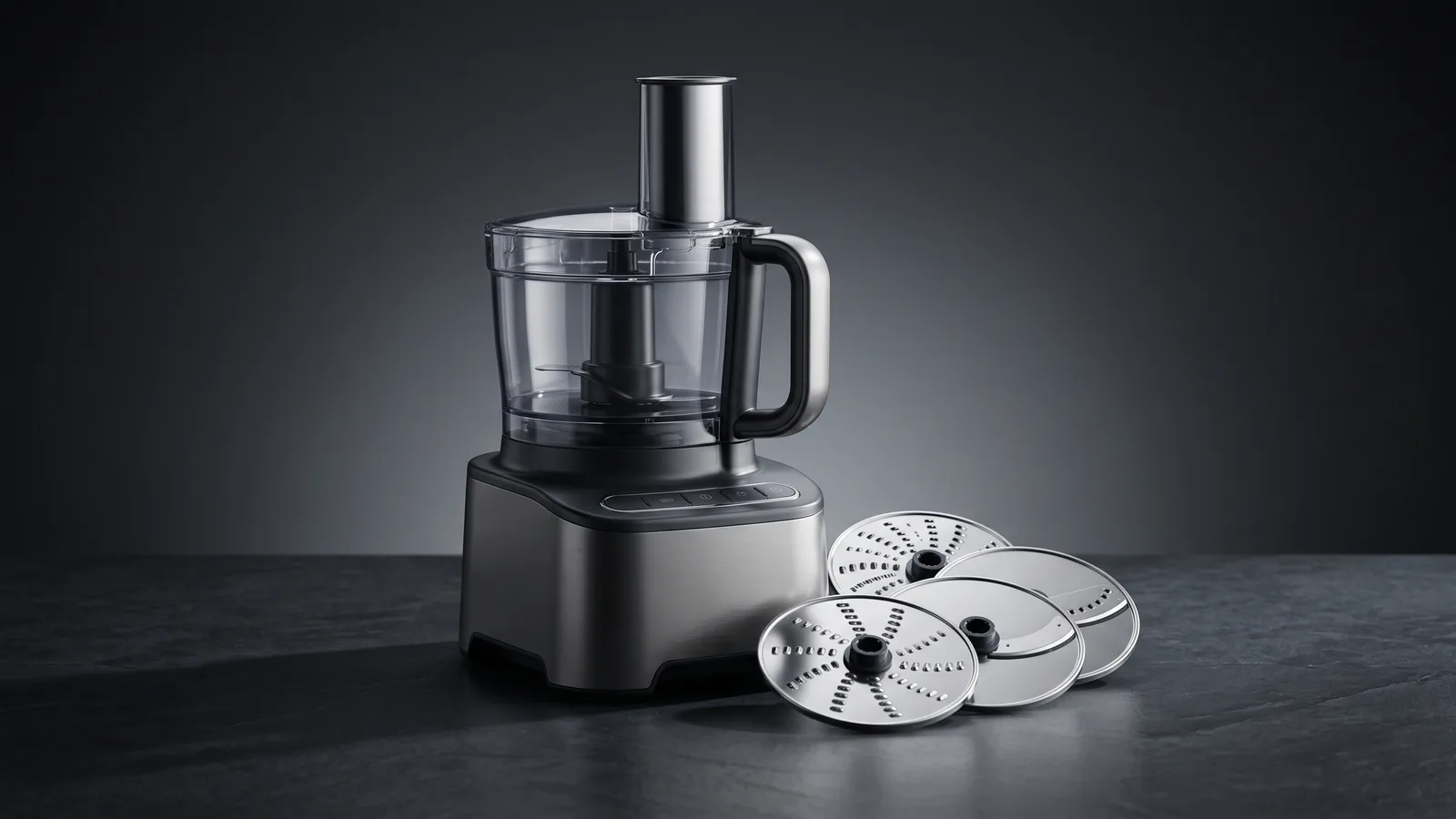
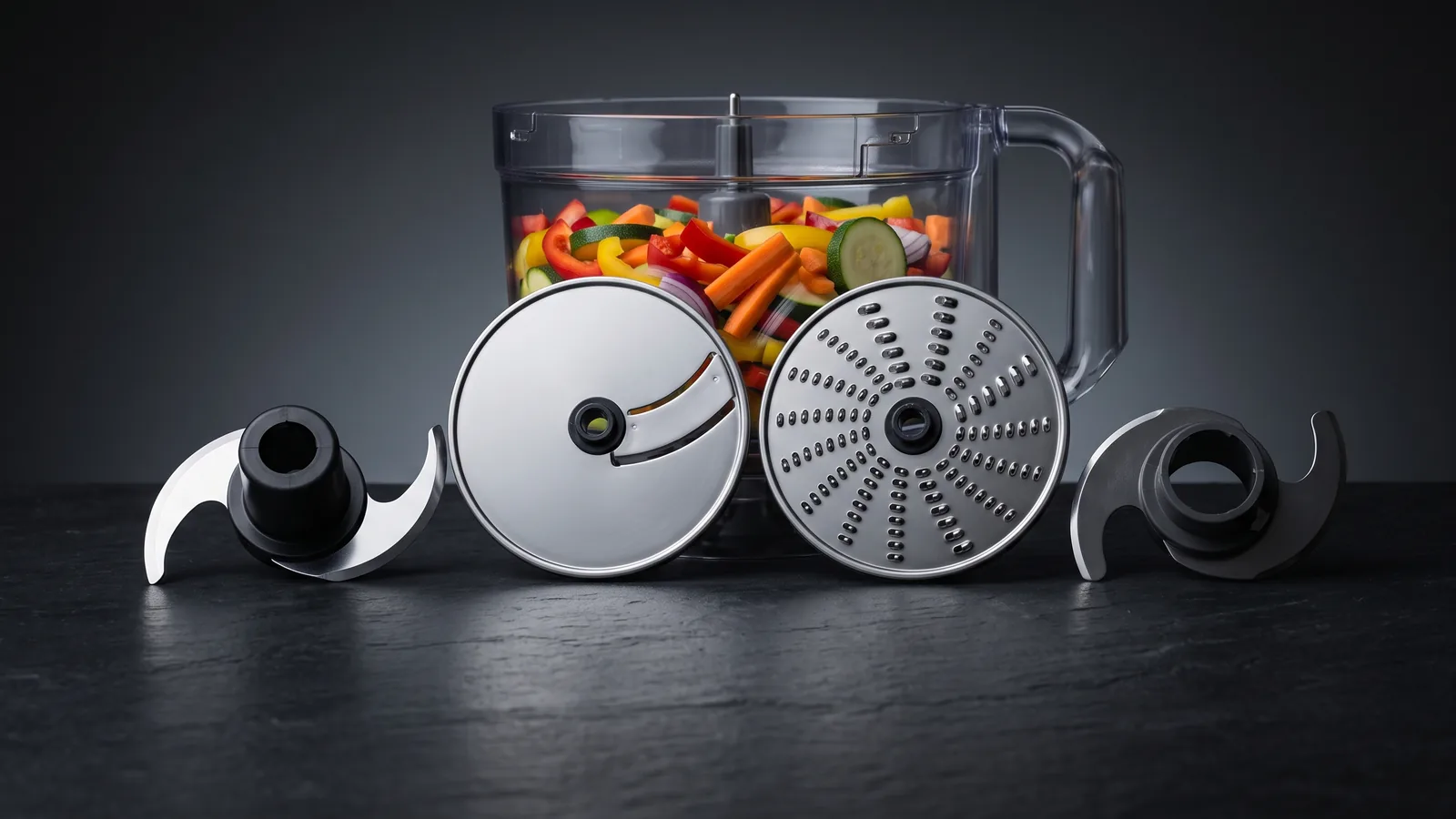
The slicing and shredding discs — flat rotating blades that attach in place of the S-blade — are where a food processor has no hand-prep equivalent for speed and uniformity.
Slicing. A slicing disc with ingredients fed through the feed tube produces uniform coins of consistent thickness. Cucumbers, zucchini, potatoes, apples, and onion rings — any firm vegetable or fruit that fits through the feed tube processes in seconds. The consistency of machine-sliced vegetables makes gratins and tarts visually uniform in a way that hand-slicing rarely achieves.
Shredding. The shredding disc produces shredded cabbage, carrots, beets, cheese, zucchini, and potatoes in seconds. A food processor shreds an 8-oz block of cheddar in under a minute. The equivalent by hand grater takes 5 minutes and produces less uniform results. For coleslaw, hash browns, or shredded cheese by the pound, the shredding disc is one of the most time-saving tools in a kitchen.
Dough (with important distinctions)
Pie crust and biscuit dough (cold fat cutting): The food processor’s most elegant baking application. Cold butter must be cut into flour to produce flaky pastry — a process that traditionally requires a pastry cutter or two knives. A food processor does it in 10–15 pulses, keeping the fat cold through the rapid processing. The result is consistently flakier pastry than most hand methods because the cold fat is cut in without being warmed by hand contact.
Pasta dough: Excellent. Eggs and flour incorporate quickly and the processing promotes even gluten development. Stop when a cohesive ball forms.
Bread dough: Feasible but requires adequate motor wattage (900W+) and a dough blade. The food processor develops gluten very quickly — bread dough can be over-processed in 45 seconds if not watched. A stand mixer with a dough hook is the better tool for bread requiring long gluten development; a food processor works well for no-knead-style breads and focaccia where shorter development is appropriate.
Dips, spreads, and purees
Hummus. Canned or cooked chickpeas plus tahini, lemon, garlic, and olive oil process to hummus in 60–90 seconds. A food processor produces a slightly textured result; a blender produces smoother. Both are valid depending on preference.
Nut butter. Dry-roasted nuts process to nut butter in 3–8 minutes of continuous processing. The nuts go through stages: coarse pieces → fine pieces → clumped paste → smooth butter. Adequate motor wattage (900W+) is important; motors below 700W often overheat on the sustained load.
Pesto. Basil, garlic, pine nuts, parmesan, olive oil — processed in 20–30 seconds. Better texture control than a blender because the food processor allows chunky or smooth depending on processing time.
Salsa. Tomatoes, onion, jalapeño, cilantro, lime juice — 5–10 pulses to a chunky salsa, 15–20 pulses to a smoother version. A food processor gives better control over texture than a blender.
Cooked vegetable purees. Roasted butternut squash, sweet potato, cauliflower mash — all process effectively. The result is slightly coarser than a blender puree, which is often preferred for more textured applications. For ultra-smooth restaurant-style purees, a blender produces a finer result.
Other tasks
Cookie and cracker crumbs. Oreos, graham crackers, saltines — process to uniform crumbs in 10–15 seconds for pie crusts and cheesecake bases.
Breadcrumbs. Stale bread to breadcrumbs in 10 seconds. Panko-style (coarser) with shorter processing; fine breadcrumbs with longer.
Grated hard cheese. Parmesan, pecorino, and other hard cheeses process to a fine grate. Easier than a box grater for large quantities.
Emulsified dressings. Vinaigrettes and Caesar dressing emulsify when oil is drizzled through the feed tube while the processor runs. The constant agitation produces a temporarily emulsified dressing that holds better than hand whisking.
What a food processor handles poorly
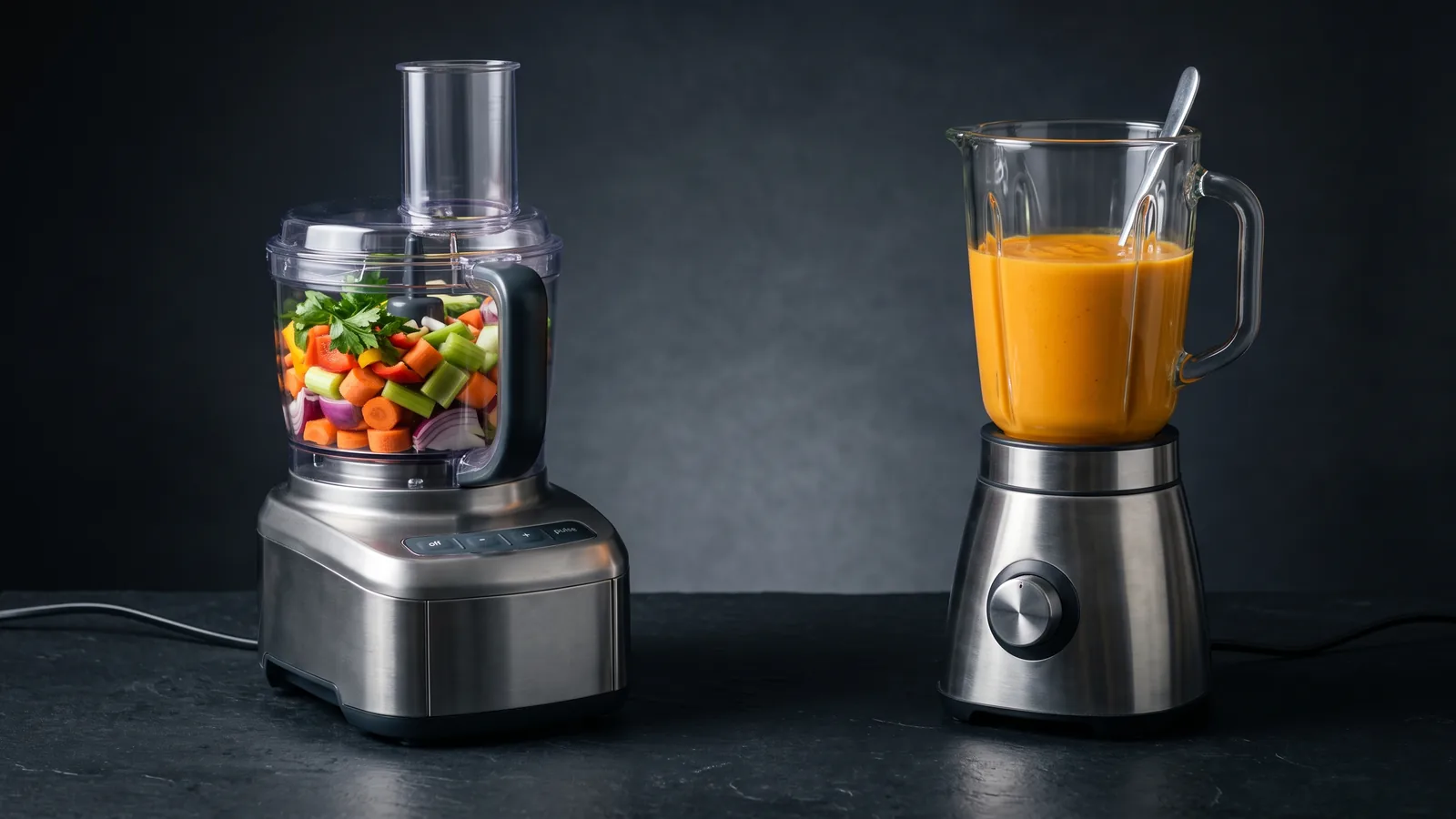
Large liquid volumes. The bowl seal is not designed for soup-scale liquid processing. Hot or large quantities of liquid can force open the seal and leak onto the motor base. For soups and smoothies, a blender is the correct tool.
Whipping and aeration. The S-blade does not incorporate air into cream, eggs, or batters. Stand mixer or hand mixer.
Grinding to fine powder. The S-blade produces an irregular grind — coarse and fine particles mixed. Coffee, spices, and grain milling require a burr grinder or dedicated grain mill for consistent results.
Crushing ice. A food processor can chop ice in small quantities but produces irregular pieces and stresses the blade and motor. A blender handles ice more effectively.
Kneading high-hydration bread dough. Wet, extensible doughs (ciabatta, sourdough at 75%+ hydration) are difficult to manage in a food processor because they stick to the bowl and blade unpredictably. Stand mixer with a dough hook is better for high-hydration bread.
Quick task reference
| Task | Food processor? | Better tool if no |
|---|---|---|
| Chop onion or garlic | Yes | Knife |
| Slice cucumbers uniformly | Yes (slicing disc) | Mandoline |
| Shred cabbage | Yes (shredding disc) | Box grater |
| Make smoothies | No | Blender |
| Make hummus | Yes | Either (blender is smoother) |
| Make pie crust | Yes | Pastry cutter or hands |
| Make bread dough | With caveats | Stand mixer |
| Whip cream | No | Stand mixer / hand mixer |
| Grind coffee | Poorly | Burr grinder |
| Make nut butter | Yes (900W+) | High-power blender |
| Puree hot soup | Avoid | Blender |
| Shred cooked chicken | Yes | Two forks |
| Make pesto | Yes | Mortar and pestle (traditional) |
How to use food processor blades and discs · Food processor vs blender · The best food processors