The blades and discs at a glance
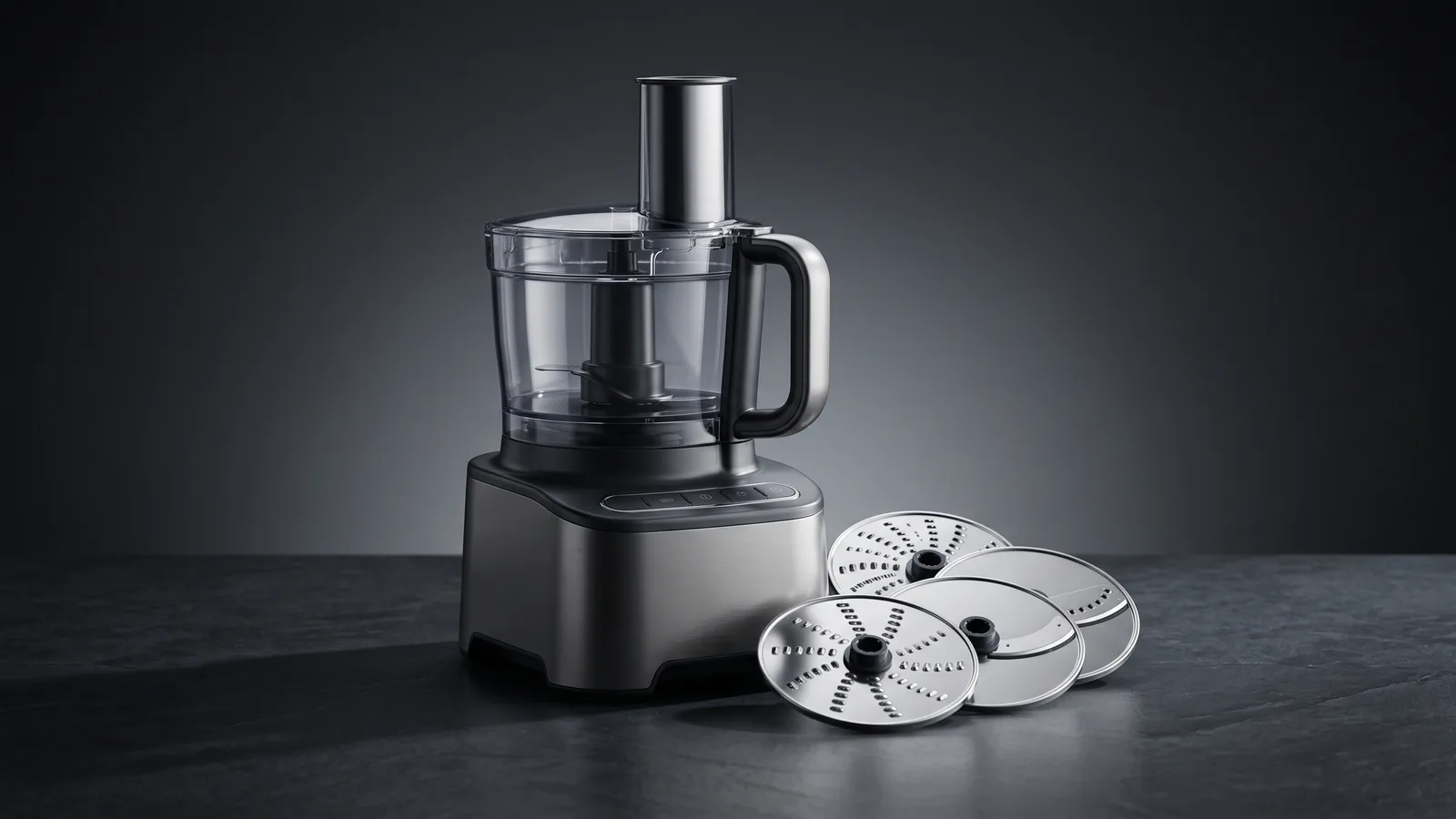
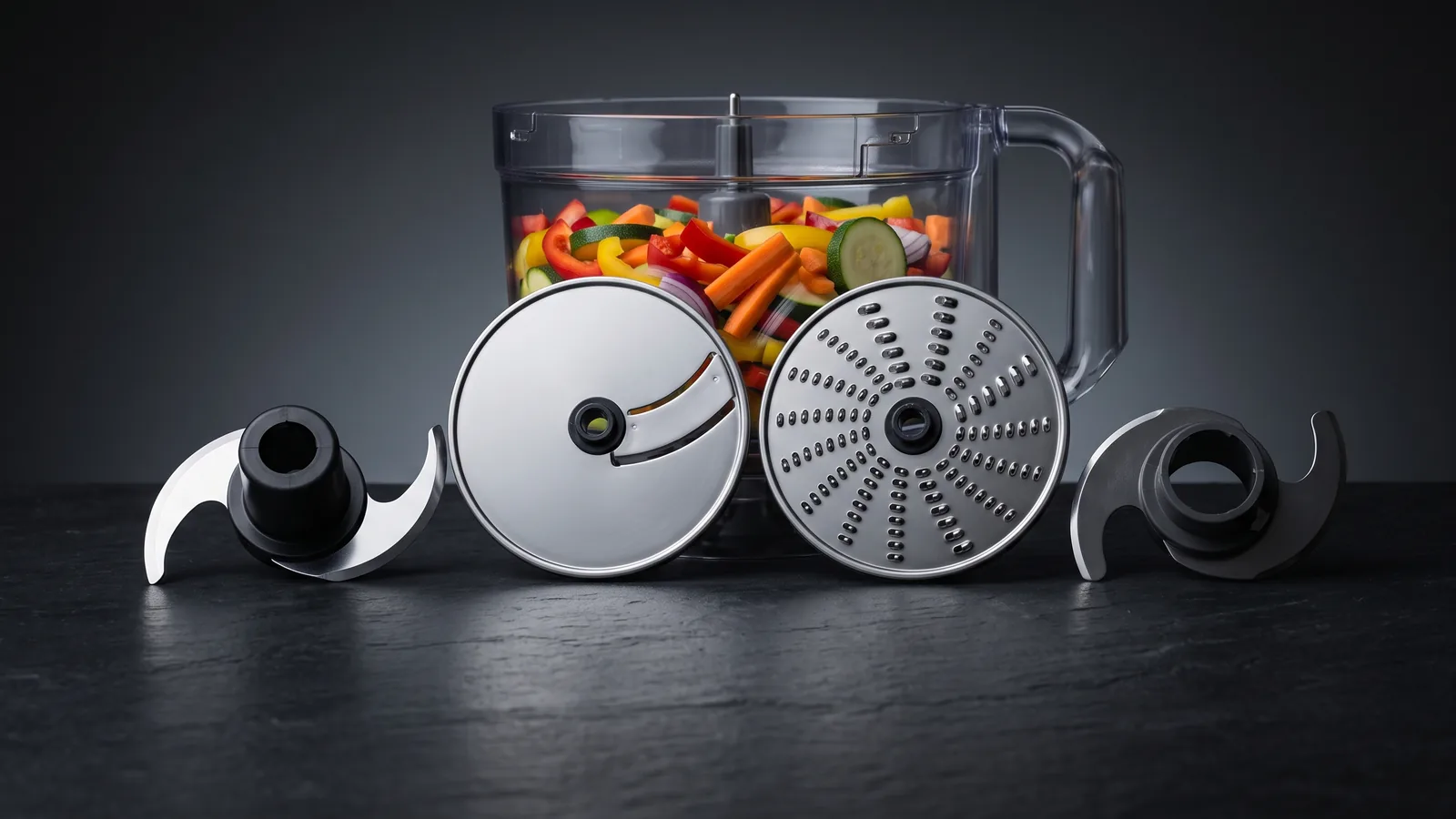
Most food processors come with four core attachments (plus a few specialty extras). Here is what each type is and when to reach for it:
| Attachment | What it is | Use it for |
|---|---|---|
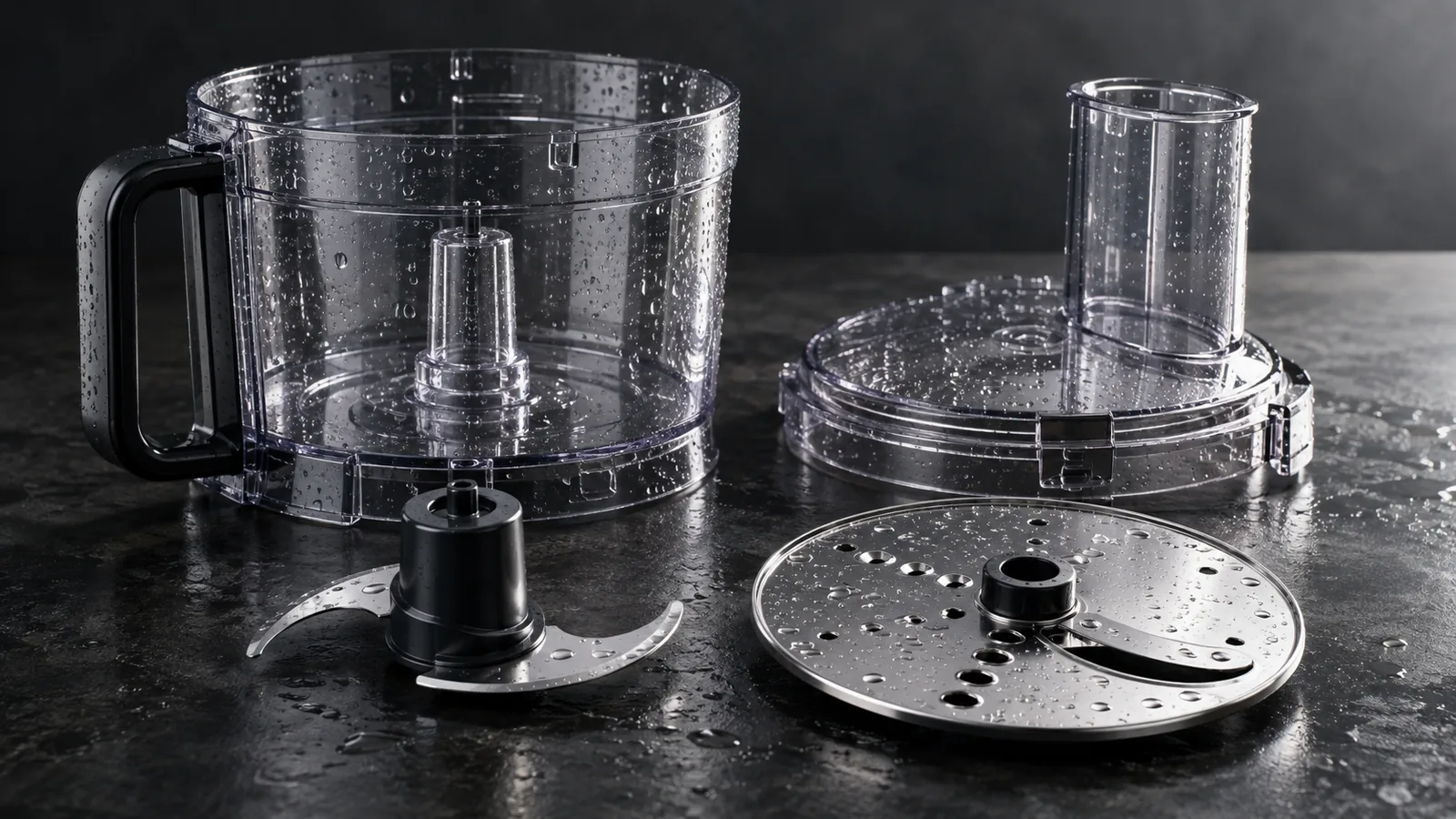
| S-blade (multipurpose / chopping / steel blade) | Curved, S-shaped double-edged blade on the center spindle | Chopping, mincing, pureeing, dips, pesto, crumbs, pastry — ~80% of tasks |
| Shredding disc | Flat disc with a raised grating surface | Cheese, cabbage, carrots, zucchini, hash browns |
| Slicing disc | Flat disc with a single raised blade | Cucumber, potato gratin, onions, apples, mushrooms |
| Dough blade (plastic) | Blunt plastic blade that folds rather than cuts | Yeast bread and pizza dough |
| Julienne / whipping / citrus | Specialty attachments | Occasional — most owners rarely need these |
The S-blade is the one that ships mounted on the spindle and does most of the work; the discs are where a food processor beats hand prep most dramatically. Each type is covered in detail below.
The S-blade (multipurpose / chopping blade)
The S-blade is the standard blade that ships with every food processor. It is shaped like a curved letter S, double-edged, and sits on a central spindle at the base of the bowl. It is the default attachment for most tasks.
How it works
The S-blade rotates rapidly through ingredients sitting in the bowl. Unlike disc processing (where ingredients are fed through a feed tube), S-blade processing places all ingredients in the bowl at once and runs the machine in continuous mode or pulsed mode.
Continuous mode: runs the blade at full speed without stopping. Used for pureeing, emulsifying, and making smooth mixtures.
Pulse mode: runs the blade in short bursts. Each pulse adds processing. Used for controlling texture — 3 pulses produces coarser pieces than 10 pulses. Pulsing is almost always preferable to continuous for chopping because it gives control over the final texture.
S-blade tasks and technique
Chopping vegetables: cut into rough 2-inch pieces; process in 5–10 pulses depending on desired fineness. Do not overcrowd — the bowl should be no more than halfway full for even processing.
Mincing garlic: add peeled cloves with machine running through feed tube, or add to stopped bowl and pulse 5–8 times. For a paste, add a small amount of salt and process longer.
Hummus and dips: add all ingredients; run continuously for 60–90 seconds, scraping down as needed. For smoother hummus, run longer and drizzle olive oil while processing.
Pesto: brief pulse to a rough chop, then continuous to desired smoothness. Drizzle oil through feed tube while running for a more emulsified texture.
Pastry dough: add flour and cold fat cut into cubes; pulse 10–15 times until the mixture resembles coarse crumbs. Add ice water one tablespoon at a time, pulsing after each addition, until the dough just comes together. Do not over-process.
Crumbs: cookies, crackers, and stale bread process to crumbs in 10–15 seconds of continuous run. For coarser crumbs, use shorter pulses.
The shredding disc
The shredding disc is a flat disc with a raised, perforated grating surface. It replaces the S-blade by sitting on the same center spindle, with the grating surface facing up. Ingredients fed through the feed tube contact the grating surface and are shredded downward into the bowl.
What it produces
Thin, uniform shreds of the ingredient — similar to what a box grater produces, but faster and more consistent.
Best uses
Cheese: cheddar, mozzarella, Swiss, gruyere, and similar semi-hard cheeses shred in seconds. Keep the cheese cold — warm cheese is soft and produces clumps rather than shreds. An 8-oz block shreds in under 60 seconds vs 5 minutes on a box grater.
Cabbage for coleslaw: quarter a head of cabbage, remove the core, feed wedges through the feed tube. A full head shreds in 90 seconds.
Carrots: peel, cut to feed-tube length, feed through. Produces uniform thin shreds suitable for salads, coleslaw, or carrot cake batter.
Zucchini: trim ends, halve lengthwise, feed through. Essential for zucchini bread — the shredded zucchini integrates into batter without chunks.
Potatoes for hash browns: peeled potatoes, quartered to fit the feed tube, produce shredded potatoes for latkes or hash browns. Squeeze out excess moisture after shredding.
Beets: produce dramatically better results in a food processor than hand-grating — beet juice stains immediately and a box grater requires significant force. Food processor shredding is fast and contained.
The slicing disc
The slicing disc has a single blade that extends slightly above the disc surface. Ingredients fed through the feed tube are sliced as they contact the blade and fall into the bowl.
What it produces
Uniform rounds or slices at a consistent thickness. Most discs slice at 2–4mm thickness. Some machines offer adjustable slicing thickness (Breville Sous Chef, KitchenAid wide-mouth models).
Best uses
Cucumbers: perfect uniform rounds for crudités, salads, or pickles. Feed through the feed tube with gentle pressure.
Potatoes (au gratin): consistent potato slices produce even cooking in gratins. Irregular hand-sliced potatoes cook unevenly — thin slices overcook before thick slices are tender.
Onion rings and rings for pizza: halved onions fed through produce rings for fajitas, pizzas, and French onion soup.
Apples (for tarts): thin, consistent slices for tarte tatin or apple cake. Keeps the presentation uniform.
Zucchini and summer squash: sliced rounds for grilling, roasting, or ratatouille.
Mushrooms: sliced for sautéing — 8 oz of mushrooms processed in under 30 seconds.
Feed tube technique for slicing
- Cut ingredients to a size that fits snugly in the feed tube without forcing
- Apply gentle, consistent pressure with the pusher — too much force produces thicker irregular slices; too little lets ingredients skip
- For long vegetables (carrots, zucchini), stand them upright in the feed tube for lengthwise slices, or lay them sideways for rounds
- For round ingredients (potatoes, apples), cut a flat edge to prevent rolling during processing
The dough blade
Most food processors include a plastic dough blade — a blunt-edged plastic attachment on the same center spindle. Unlike the S-blade, its purpose is to push and fold rather than cut.
When to use it
The dough blade is specifically for bread dough and pizza dough — yeast-leavened doughs that require gluten development through kneading. Its blunt edge works the dough by repeated folding without cutting through the gluten strands that give bread its structure.
The S-blade can also make dough but processes more aggressively — the sharper edge is more likely to over-develop or cut gluten. For bread dough where texture matters, the dough blade is the better choice.
For pastry dough (pie crust, biscuits): use the S-blade, not the dough blade. Pastry requires minimal gluten development — you want the fat cut into the flour quickly without developing toughness. The S-blade’s quick pulse technique is correct here.
How to use it
Add flour first, then yeast and salt. Add water while the machine runs. Process until the dough pulls away from the sides and forms a ball — typically 45–60 seconds. Do not over-process bread dough; a food processor develops gluten quickly and 90 seconds of processing can produce a tight, over-worked dough.
Attachments buyers consistently underuse
Shredding disc: the most underused accessory by buyers who primarily use the S-blade. The time savings for shredding cheese, cabbage, and carrots are among the most dramatic in any kitchen task. Buyers who learn the shredding disc typically report using it weekly.
Slicing disc: less frequently used than shredding, but the application for gratins and cucumber crudités produces results that are difficult to replicate by hand.
What most buyers never use: julienne disc (impressive in theory; in practice, most buyers find regular shredded vegetables sufficient), whipping disc (a stand mixer or hand mixer is better for this), and citrus juicer attachment (a hand reamer is faster for the task most buyers need).
Blade care and safety
The S-blade is extremely sharp. Always handle it by the central hub, never by the blade edges. Never reach into the bowl blindly with the blade in place.
Most blades and discs are dishwasher-safe, but hand washing extends blade sharpness significantly — dishwasher detergent is mildly abrasive and dulls cutting edges over time. Rinse immediately after use to prevent food from drying onto the blade.
Store blades in the included blade storage case or in the bowl with the lid on — never loose in a drawer where they contact other utensils.
What can a food processor actually do · How to clean a food processor · The best food processors