What limescale is and why it matters
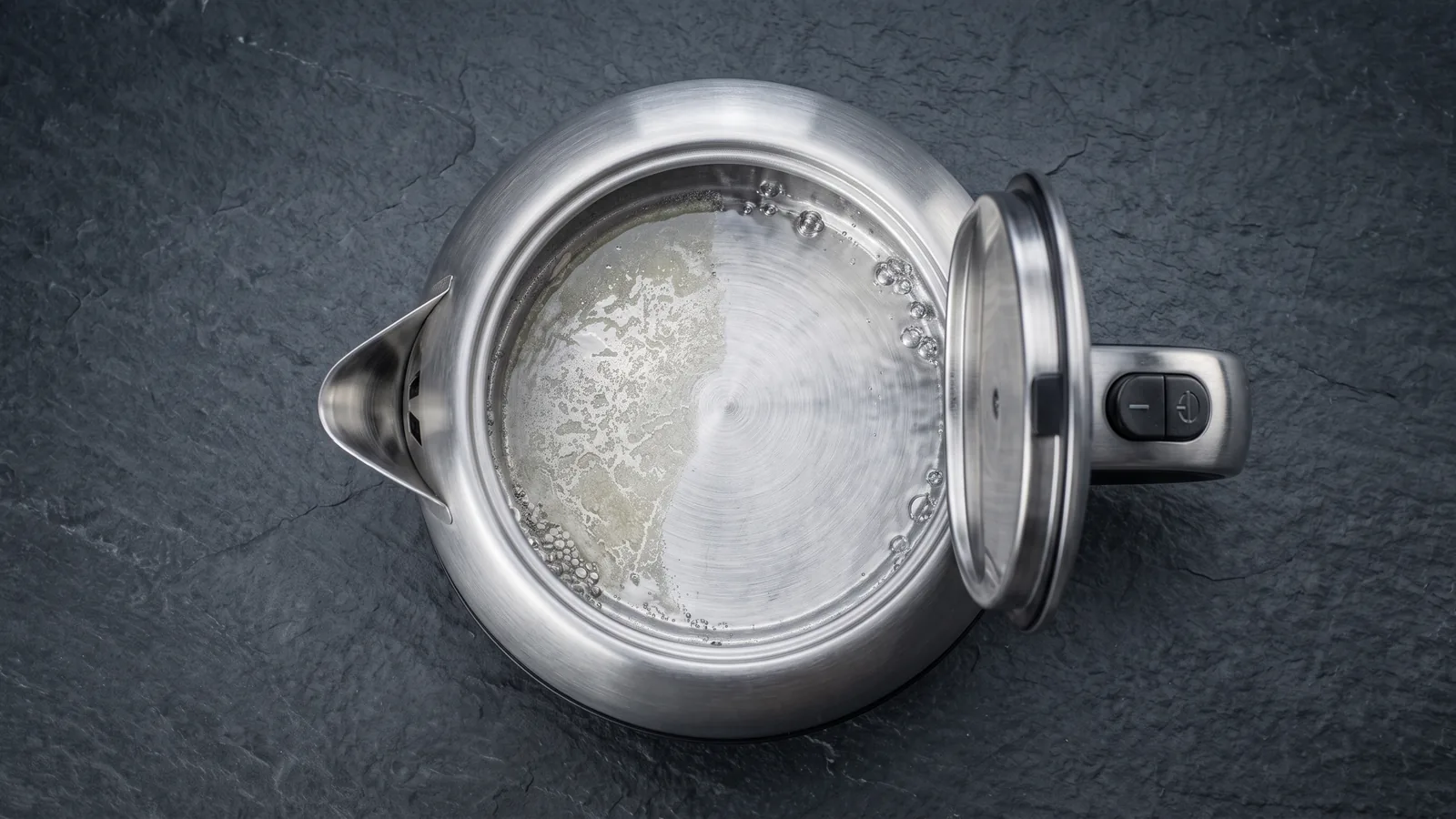
Limescale is calcium carbonate (CaCO₃) and magnesium carbonate (MgCO₃) — dissolved minerals that precipitate out of water when it is heated. They appear as a white or gray chalky coating on the interior walls of the kettle and, most critically, on the heating element.
Scale accumulates with every boil cycle. The rate depends on water hardness — the concentration of dissolved calcium and magnesium in the local water supply.
Why it matters:
Performance. Scale insulates the heating element. An insulated heating element transfers heat less efficiently, which means longer boiling times and higher energy consumption for the same result. A kettle with significant scale buildup can take 30–50% longer to reach a boil.
Taste. Scale particles that break off the interior walls end up floating in the boiled water — visible as white flakes or a chalky taste. The water is not unsafe, but the taste and appearance are unpleasant.
Appliance life. A heating element under persistent scale stress runs hotter than it should, degrading faster. Regular descaling is the single most effective maintenance action for extending kettle life.
How to tell if your kettle needs descaling
Visible signs:
- White or gray crusty coating on the interior walls
- White flakes floating in boiled water
- A whitish film on the heating plate at the base
- Discoloration around the water-level window or spout
Performance signs:
- Noticeably longer boiling time than when the kettle was new
- Kettle runs louder or differently than before (scale on the element changes the heating sound)
Taste signs:
- Faint chalky or mineral taste in freshly boiled water
- Tea or coffee tastes different from the same tea/coffee brewed elsewhere
If any of these appear, descaling is overdue. In hard water areas, routine monthly descaling prevents these signs from developing.
Method 1: White vinegar
White vinegar is the most universally available descaling agent. The acetic acid (typically 5% concentration in distilled white vinegar) dissolves calcium carbonate and magnesium carbonate effectively.
What you need: distilled white vinegar, water
Steps:
- Fill the kettle to the halfway mark with a 1:1 mixture of white vinegar and water
- Boil the solution
- Switch off and leave the solution in the kettle for 20–30 minutes
- Pour out the solution
- Fill the kettle with fresh water and boil — this rinse cycle removes vinegar residue and loosened scale
- Empty and repeat the rinse once more
- Before using the kettle, do a final rinse with cold water and check for residual vinegar smell. If present, repeat the rinse cycle
For stubborn scale: increase the vinegar concentration to 2:1 (vinegar to water) and extend the soak to 1 hour. For scale that is visually thick and crusty, a soft cloth or bottle brush to gently wipe the interior after the soak removes the loosened deposits before rinsing.
Note: the vinegar smell is persistent and requires thorough rinsing. Two to three rinse cycles with fresh boiling water are typically needed. Using the kettle for tea or coffee before the smell is fully gone will transfer the vinegar taste to the drink.
Method 2: Citric acid (preferred)
Citric acid is the method recommended by most kettle manufacturers. It is as effective as vinegar against limescale and leaves no residual odor.
What you need: food-grade citric acid powder (available in grocery stores — baking aisle or natural foods section — and online)
Steps:
- Fill the kettle to the halfway mark with water
- Add 1 tablespoon of citric acid powder per 500ml of water. Stir briefly if accessible, or simply place the powder in before adding water
- Boil the solution
- Switch off and leave for 15–20 minutes
- Pour out the solution
- Fill with fresh water and boil once to rinse
- Empty and use normally — citric acid rinses cleanly without residual odor
For stubborn scale: increase to 2 tablespoons per 500ml and extend soak to 30–45 minutes.
Citric acid is the better choice for glass kettles where the interior is fully visible — it makes the result of the descaling process easy to evaluate.
Method 3: Commercial descaler
Branded kettle descalers (Durgol Swiss, Oust All Purpose Descaler, and similar) are food-safe acidic solutions packaged for convenience. They are effective and require no measurement or mixing.
Steps: follow the manufacturer’s instructions on the specific product. Generally: add the solution to the kettle, fill to the recommended level with water, boil, let sit, pour out, rinse.
The active ingredient is typically citric acid, lactic acid, or malic acid — functionally equivalent to the citric acid method above. The cost per use is higher (typically $3–$8 per descale vs. cents for bulk citric acid) but the convenience is genuine.
How often to descale
Frequency depends entirely on water hardness. Water hardness is typically measured in grains per gallon (GPG) or milligrams per liter (mg/L) of calcium carbonate. Local water utilities publish this data.
| Water hardness | Hardness level | Recommended descaling frequency |
|---|---|---|
| 0–3 GPG / 0–60 mg/L | Soft | Every 3–4 months |
| 3–7 GPG / 60–120 mg/L | Moderately hard | Every 2 months |
| 7–10 GPG / 120–180 mg/L | Hard | Monthly |
| 10+ GPG / 180+ mg/L | Very hard | Every 2–3 weeks |
US cities with notably hard water (Phoenix, Las Vegas, Dallas, Denver, Indianapolis) typically fall in the hard to very hard range. Cities with soft water (Seattle, Portland, Boston, New York) require less frequent descaling. UK water hardness varies significantly by region — the southeast (London, Brighton) is hard to very hard; Scotland and Wales are soft to moderately hard.
The simplest approach: check the interior monthly. If scale is visible, descale. This avoids both under-descaling (which allows buildup to damage the element) and over-descaling (which is merely extra effort, not harmful).
What not to use
Lemon juice. Less concentrated than citric acid, requires more product for the same effect, and leaves a residue that may produce a faint flavor. Use citric acid powder instead.
Baking soda (sodium bicarbonate). Does not dissolve limescale. Baking soda is alkaline; limescale is a base. Acid dissolves it; alkali does not. Baking soda cleans organic residue and odors but is ineffective against mineral scale.
Bleach or chlorine-based cleaners. Never. Bleach can damage stainless steel passivation and leaves residue that is harmful if ingested. The interior of a kettle requires only food-safe acidic descaling — nothing stronger.
Abrasive scrubbers on the interior. Scratching the interior surface of a stainless steel kettle creates micro-abrasions that accelerate future scale adhesion and damage the protective oxide layer. Use only soft cloths or bottle brushes.
After descaling
After descaling and rinsing, the interior of the kettle should be visibly free of white coating. If scale remains in localized spots — particularly around the heating element or at the waterline — repeat the descaling process with a slightly stronger solution.
A freshly descaled kettle will boil at the same speed as a new kettle. If boiling time remains significantly longer than expected, the heating element may have sustained permanent thermal damage from extended operation under heavy scale — a sign that descaling was overdue. In this case, the slower boil time is a permanent characteristic, not something descaling will reverse.
How to choose an electric kettle · Electric kettle materials explained · The best electric kettles