Shopping from Ireland or the UK? The advice below applies everywhere, but the kettles we recommend link to US Amazon listings — and a US kettle won’t run on Irish and UK 230V mains. For 230V picks on Amazon UK (which delivers to Ireland), see the best electric kettles in Ireland — including a plastic-free stainless one.
The two decisions that drive everything else
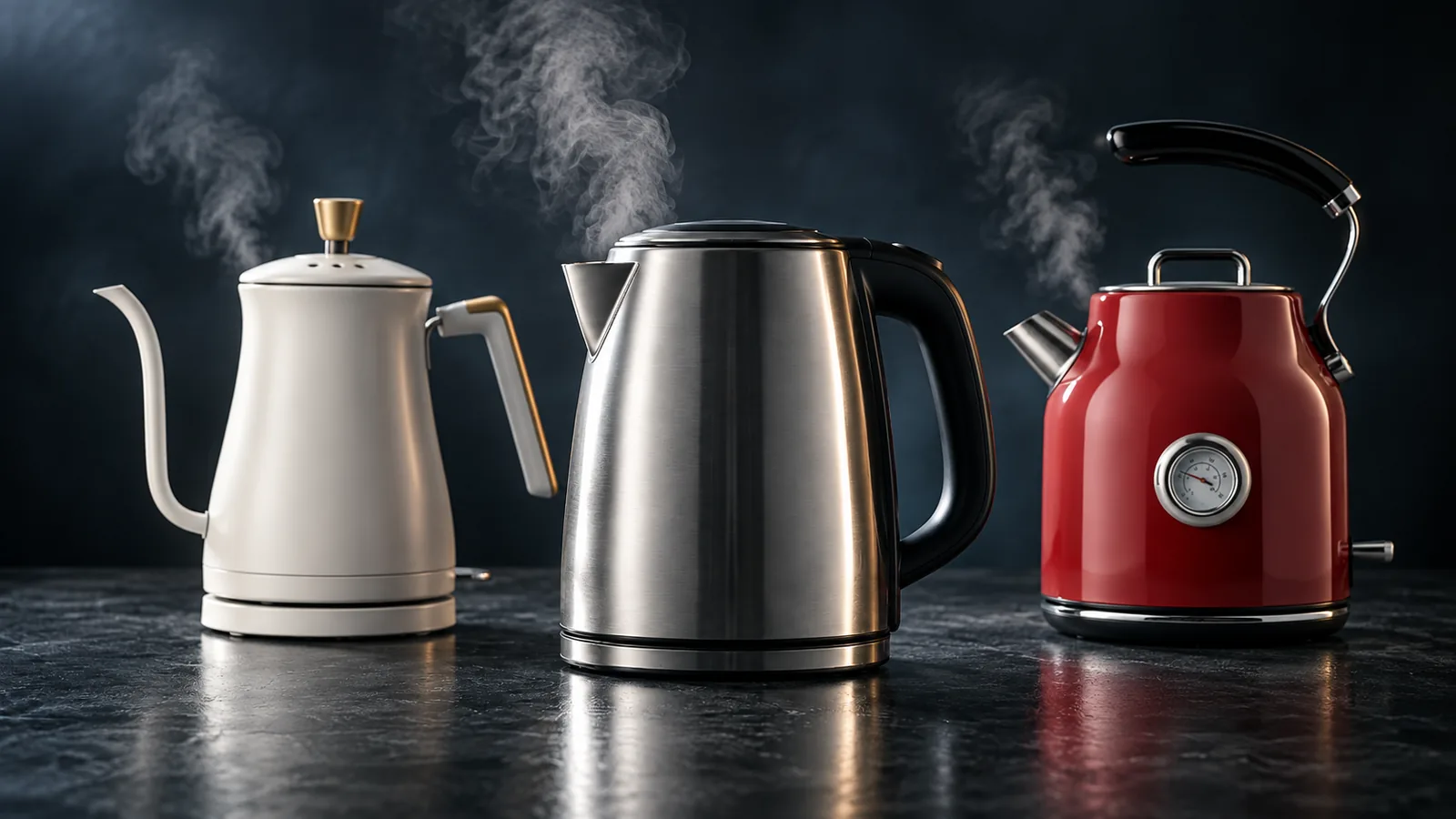
An electric kettle is a simple appliance. It boils water and, in better models, holds it at a specific temperature. The buying decision has been complicated by a crowded market with overlapping feature sets, but it reduces to two questions:
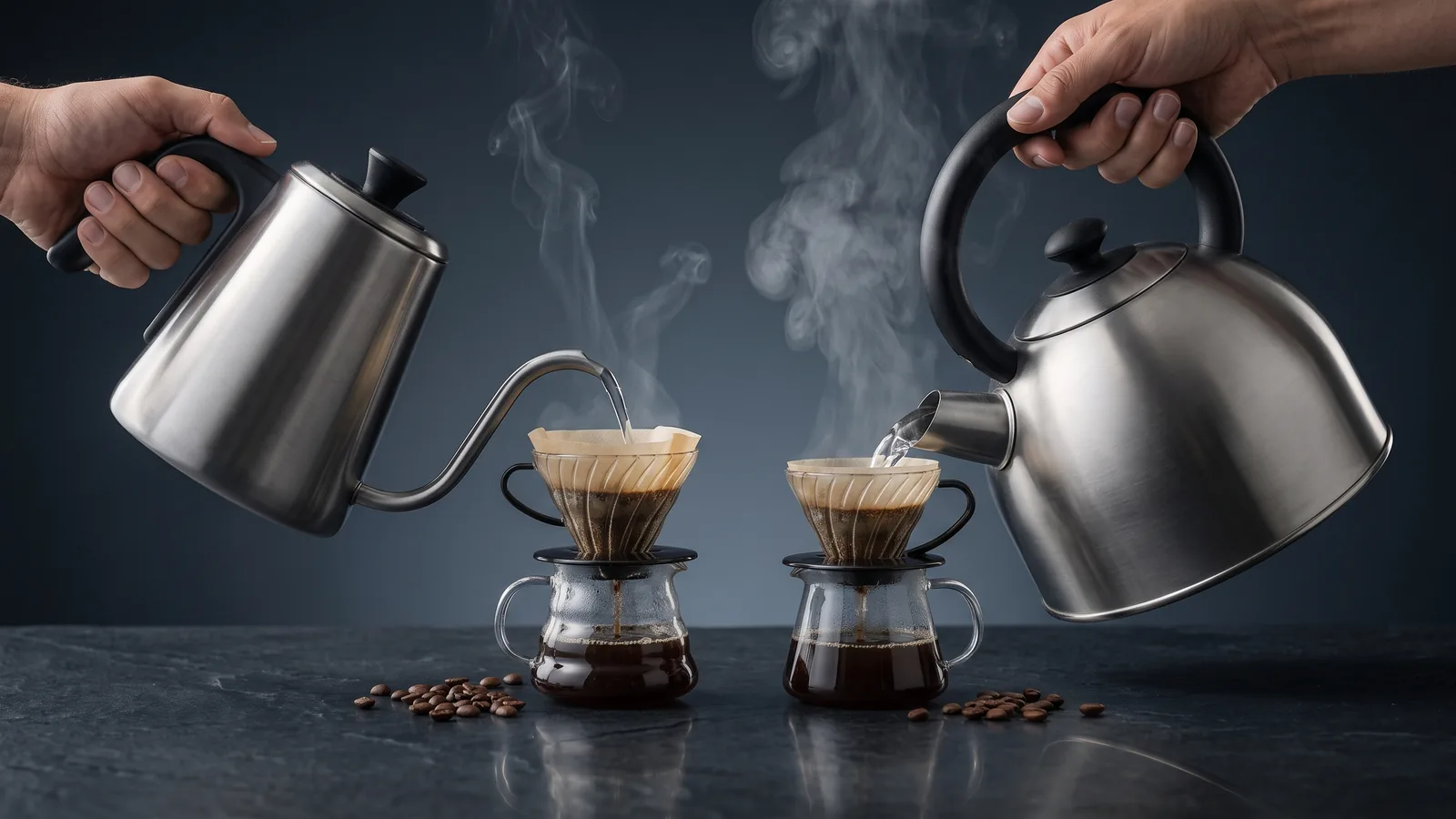
1. What spout shape do you need? A gooseneck spout — long, narrow, curved — gives the user precise control over pour rate and direction. A standard wide spout pours faster but with less control. Full comparison here.
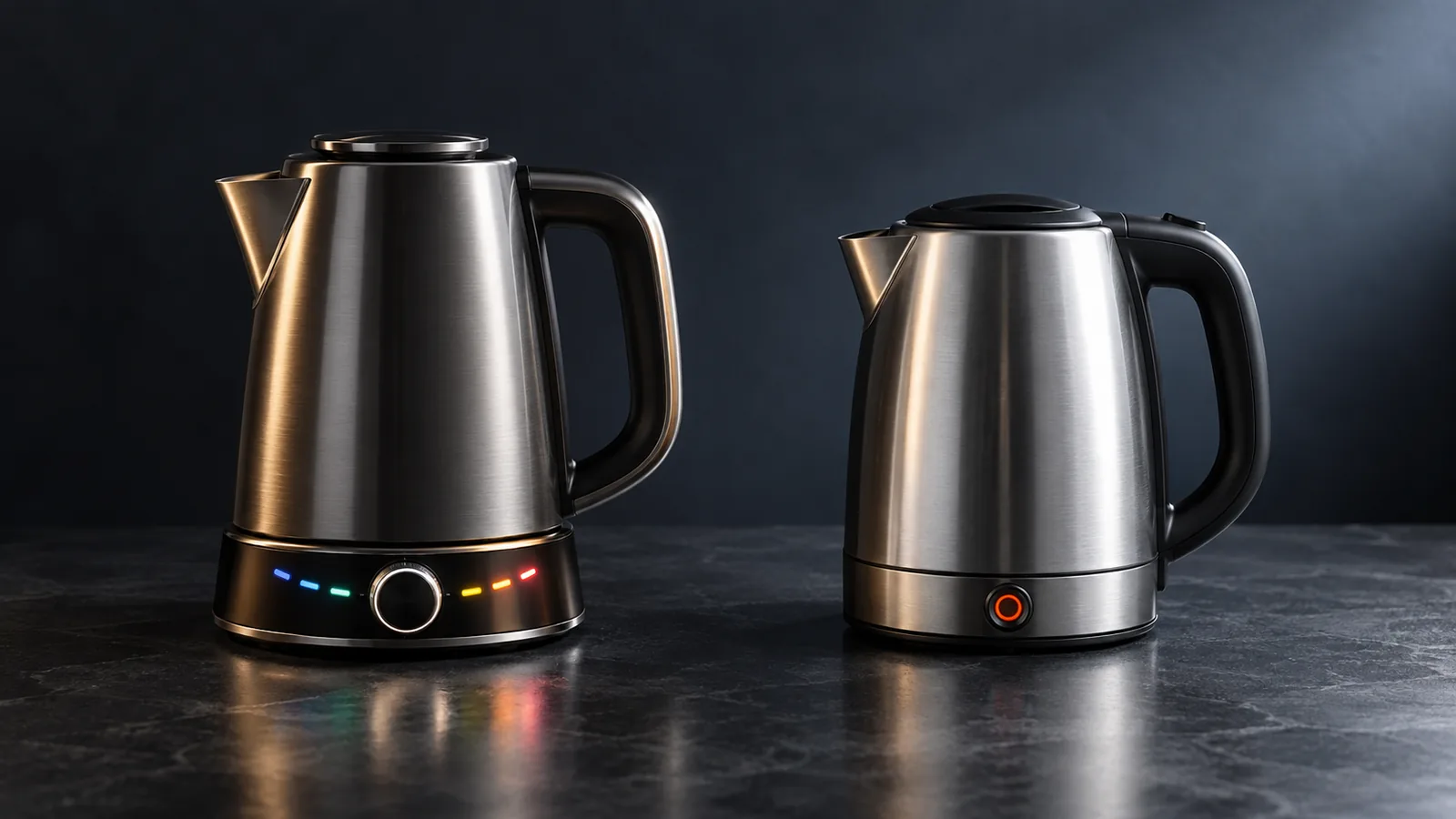
2. Do you need variable temperature? A single-boil kettle heats to 100°C (212°F) and stops. A variable-temperature kettle lets the user set a specific target — typically in 5°F increments — and holds it. When it matters and when it doesn’t.
These two decisions determine which category of kettle is right. Every other specification — wattage, capacity, material, keep-warm duration, display type — is calibration within the chosen category.
Spout type
Standard spout
Pours quickly, fills mugs and pots without particular technique, and is adequate for any use that doesn’t require a controlled pour rate. For most buyers who boil water for black tea, instant coffee, oatmeal, soup cups, or cooking — this is the right choice. Standard spouts appear on the full range from budget to mid-tier kettles and cost nothing extra.
Gooseneck spout
The gooseneck spout exists for one reason: to slow and control the pour. In pour-over coffee, the extraction quality depends on saturating grounds evenly and maintaining a steady spiral pour; a gooseneck makes this possible without skill. For loose-leaf tea in a teapot, a gooseneck allows filling without disturbing the leaves. For any use that requires pouring accuracy, the gooseneck is not a premium — it is the correct tool.
The trade-off: a gooseneck pours more slowly than a standard spout by design. Filling a large pot or multiple mugs quickly is awkward with a gooseneck. Buyers who use the kettle for both pour-over coffee and general boiling find this manageable; buyers who primarily need speed find it irritating.
Rule: if pour-over coffee or precise loose-leaf tea brewing is in the routine, buy a gooseneck. Otherwise, buy a standard spout.
Temperature control
Single boil
Heats water to boiling and shuts off. No presets, no display, no temperature selection. This is the right choice when the use case is black tea, herbal infusions, French press coffee, instant products, cooking, or anything that benefits from hot or boiling water rather than a specific temperature.
Single-boil kettles start around $20 and cover the full quality range up to mid-tier. The mechanism is simple and durable — fewer components means fewer failure points.
Variable temperature
Allows the user to set a target temperature — typically between 140°F and 212°F — before boiling. The kettle heats to the set point and either shuts off or holds at that temperature for a keep-warm period (typically 30 minutes to 2 hours depending on the model).
Variable temperature is worth the premium when the routine includes:
- Green tea — brewed at 165–180°F; boiling water produces a bitter, astringent result
- White tea — brewed at 160–185°F; extremely sensitive to overheating
- Oolong tea — brewed at 185–205°F depending on oxidation level
- Pour-over and drip coffee — optimal extraction at 195–205°F, not boiling
- Baby formula — specific temperature required, keep-warm useful for night feeds
If none of these apply to the household routine, variable temperature adds cost and complexity without benefit.
Capacity (what size kettle to get)
The standard electric kettle size is 1.7L (about 7 cups) — the most common full-size capacity. The common personal size is 1.0–1.2L, and 0.5–0.8L is travel size. Match the size to your household:
| Use case | Recommended capacity |
|---|---|
| Single person, 1–2 cups per session | 0.8–1.0L |
| Two people, or one person making a full pot | 1.0–1.2L |
| Family, or office with multiple users | 1.5–1.7L |
| Travel or extremely limited counter space | 0.5–0.8L |
The most common capacity regret runs in one direction: too small. A buyer who needs 1.5L but buys a 1.0L model runs two boil cycles daily — that friction compounds. A buyer who needs 1.0L but buys a 1.7L model has a heavier, less agile kettle and wastes energy boiling unneeded water.
Most kettles sold in North America are 1.0–1.7L. The decision is usually between a 1.0L personal-size and a 1.5–1.7L family-size.
Material
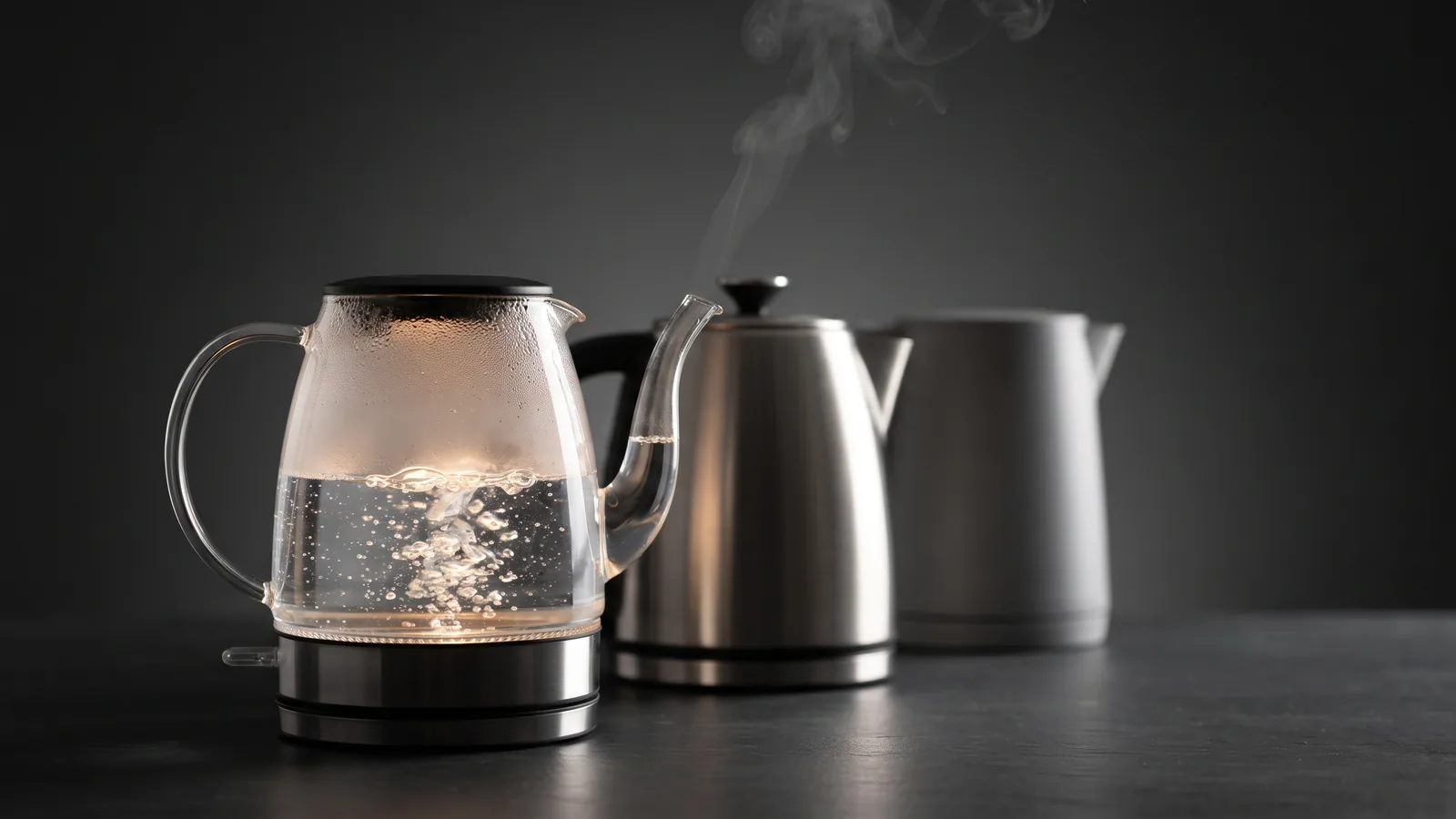
Stainless, glass, and plastic each have distinct trade-offs. Full breakdown here.
The short version: stainless is durable and doesn’t affect taste when the interior is brushed or polished; glass lets you see the water level and scale buildup but is heavier and breakable; plastic is lightest and cheapest but the most common source of off-taste complaints, particularly in budget models where plastic contacts water at temperature.
If a material is already driving your choice, here are the picks for each:
- Glass — the best glass electric kettles: watch the boil and taste-neutral, weighed against the weight, breakability, and visible scale.
- Stainless steel — the best stainless steel electric kettles: the durable, taste-neutral default — ranked by which ones have a genuine stainless water path, not just a stainless body.
- No plastic touching the water — the best plastic-free electric kettles: a stainless or glass water path end to end, with nothing plastic in the way.
Wattage and boil speed
Higher wattage boils water faster. At typical household quantities (0.75–1.5L):
| Wattage | Time to boil 1L |
|---|---|
| 1000W | ~6 minutes |
| 1500W | ~4 minutes |
| 1800W | ~3 minutes |
The practical difference between 1500W and 1800W is under 90 seconds per boil. For most buyers, this is not a meaningful factor. 1500W is the standard for full-size kettles. Models rated below 1000W are primarily travel kettles with reduced voltage compatibility.
Wattage does not indicate build quality, temperature accuracy, or durability. A 1500W kettle with a thermostat that holds 175°F reliably is a better kettle than a 1800W model that overshoots by 15 degrees.
Keep-warm
Keep-warm holds water at or near the set temperature after boiling — typically for 30 minutes to 2 hours. It is useful for:
- Pour-over sessions where multiple cups are brewed in succession
- Baby formula preparation during night feeds
- Households where the kettle is used intermittently throughout the morning
Keep-warm is a convenience feature, not a core capability. It adds to price. For buyers who pour immediately after boiling, it adds nothing.
Note: keep-warm accuracy varies significantly between models. A kettle advertised as “keep-warm at 175°F” that drifts to 165°F within 20 minutes is not performing as claimed. Temperature accuracy during keep-warm is worth checking in buyer reviews before purchasing a kettle specifically for this feature.
The decision in one table
| Your primary use | Spout | Temp control | Capacity |
|---|---|---|---|
| Black tea, instant coffee, cooking | Standard | Single boil | Match household size |
| Green / white / oolong tea | Standard or gooseneck | Variable | Match household size |
| Pour-over coffee | Gooseneck | Variable | 1.0–1.2L typical |
| Baby formula | Standard | Variable + keep-warm | 1.0–1.5L |
| Office, multiple users | Standard | Single boil or variable | 1.5–1.7L |
| Travel | Standard | Single boil | 0.5–0.8L |
See the kettle that fits your use
The table tells you what to look for — these take you straight to the vetted shortlist for each use, so you are choosing among a few credible models, not dozens of near-identical ones:
- Black tea, instant coffee, cooking — the best electric kettles; a fast boil-only kettle is all you need.
- Green, white or oolong tea — the best kettle for tea; variable temperature is the one feature that matters.
- Pour-over coffee — the best gooseneck electric kettles for a precise pour, or the wider pour-over kettle picks.
- Baby formula or all-morning sipping — a variable-temperature kettle with keep-warm.
- A small kitchen or travel — the best kettle for small kitchens, or the best travel kettles.
Our pick once you’ve weighed the factors
For most buyers the decision lands on a fast, well-made, boil-only kettle at a fair price — and that is the pick below, the overall choice in our best electric kettles guide. If temperature control is a priority for you (green tea or pour-over), skip it and see the best variable-temperature kettles instead — or, for pour-over precision specifically, the best gooseneck electric kettles.

Russell Hobbs Honeycomb 1.7L Cordless Kettle
The safe default once you've weighed the factors here — the kettle most Irish kitchens reach for first. A full 1.7L capacity, a fast rapid-boil element, a cordless 360° base and a washable filter, at a fair price, on one of the largest and best-rated owner bases of any kettle. It's a single-temperature boil (if you need variable temperature, see the guide linked above), and a 230V model on Amazon UK, which delivers to Ireland.
Prime Day Amazon Prime Big Deal Days is on — a good time to check the live price.
Check current price on Amazon.co.ukWhat buyers praise
- Fast rapid-boil; full 1.7L capacity
- Trusted brand with a huge, well-rated owner base
- Cordless 360° base and washable filter
- 230V for Irish and UK mains; delivers to Ireland
What buyers flag
- Standard plastic water window (not plastic-free)
- Single-temperature boil, not variable