The two distinct cleaning jobs
Drip coffee maker cleaning involves two separate tasks that address different sources of flavor degradation:
1. Coffee oil and residue removal (carafe, basket, filter holder)
Coffee contains oils that coat every surface they contact. These oils go rancid within 1–3 days at room temperature, and the rancid oil film transfers a stale, bitter flavor to every subsequent brew. This is the most common cause of coffee that “doesn’t taste as good as it used to” despite using the same beans and grind.
2. Mineral descaling (heating element, water lines, spray head)
Minerals in tap water — primarily calcium and magnesium — precipitate out as scale (limescale) when water is heated. Scale coats the interior of the heating element and water lines, reducing heat transfer efficiency and restricting water flow. This causes the machine to brew cooler and slower over time, which degrades extraction quality independently of the coffee oil issue.
Both problems are real; both need regular attention; and neither task addresses the other. A machine with a spotless carafe can still be building up scale inside. A recently descaled machine can still have rancid oil coating the basket.
Part 1: Regular cleaning (carafe, basket, filter holder)
After every use
Carafe: empty remaining coffee immediately. Coffee left in the carafe continues to degrade and coats the interior with a stronger rancid-oil film over time. Rinse with hot water.
Filter basket: remove used grounds and paper filter immediately. Spent grounds generate heat and moisture as they sit, creating a surface for mold and accelerating oil rancidity on the basket surface.
Quick rinse: both the carafe and basket benefit from a hot water rinse after each use to remove the thin oil film before it has time to set.
Weekly deep cleaning
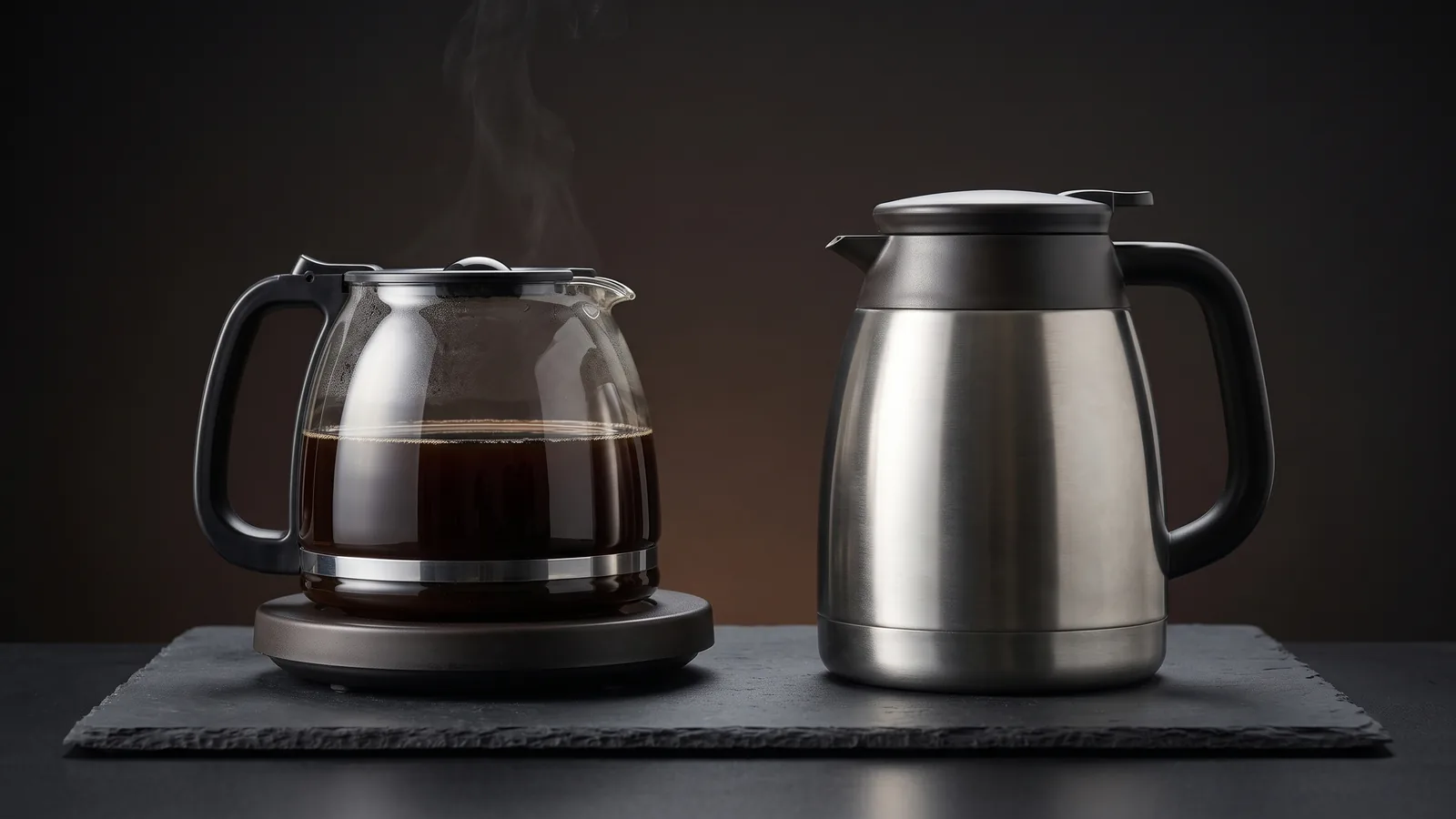
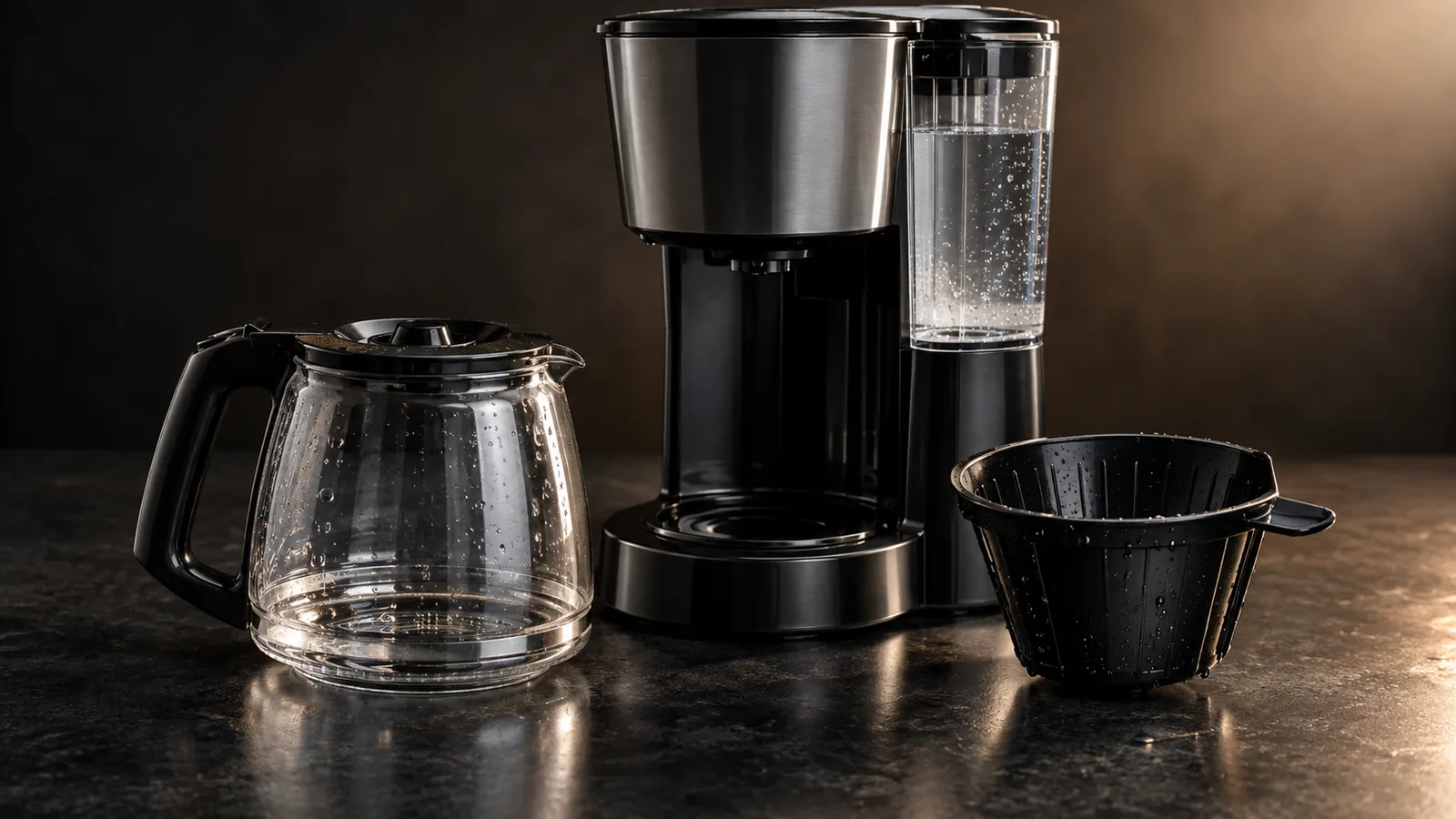
Carafe (glass): most glass carafes are dishwasher-safe on the top rack. If washing by hand, use warm water, dish soap, and a soft bottle brush or sponge. Pay attention to the bottom interior where oil concentrates and around the pour spout. For stubborn brown staining: fill with hot water and add 1 tablespoon of baking soda; let sit for 30 minutes; scrub and rinse.
Carafe (thermal): thermal carafes are often not dishwasher-safe — check the manufacturer’s instructions. Hand wash with warm water and mild dish soap using a long bottle brush to reach the interior bottom. For coffee staining: fill with hot water and add 1 tablespoon of baking soda or a dedicated coffee equipment cleaner (Cafiza, Urnex); let sit 20–30 minutes; rinse thoroughly.
Filter basket: dishwasher-safe on most machines. Hand-wash alternative: warm water, dish soap, soft brush. For staining: brief soak in a dilute white vinegar solution (1 part vinegar to 3 parts water).
Warming plate: wipe with a damp cloth when cool. Spilled coffee burns onto the warming plate and creates carbon deposits that can smell when heated. A gentle scrub with baking soda paste removes stubborn deposits without scratching.
Water reservoir: wipe with a damp cloth or rinse with clean water monthly. Mineral deposits can accumulate on the reservoir walls independently of the internal water lines.
Part 2: Descaling the machine
How to tell if descaling is needed
Performance signs:
- Brew cycle takes significantly longer than when the machine was new
- Coffee tastes weaker or flatter despite using the same beans and ratio
- Machine is louder or produces unusual sounds during brewing
- Coffee temperature is noticeably lower than before
Visual signs:
- White or gray mineral deposits visible inside the water reservoir
- Scale around the spray head holes
- Mineral film on the carafe-seating area
Time-based rule: in hard water areas, descale monthly regardless of signs. In soft water areas, every 2–3 months. Never let it go more than 6 months regardless of water hardness.
Method 1: White vinegar
- Fill the water reservoir to capacity with a 1:1 mixture of white vinegar and water
- Place the carafe in position (no coffee grounds or filter needed)
- Run a full brew cycle
- Allow the machine to sit idle for 30 minutes with the vinegar-water mixture in the carafe — this allows the acidic solution to work on any buildup in the outlet and spray head
- Discard the vinegar solution
- Run two full cycles with fresh, clean water to flush all vinegar residue
- Before brewing coffee, check for any residual vinegar smell. If present, run one more clean water cycle
Note on vinegar concentration: the 1:1 ratio works for routine maintenance. For machines with significant buildup (not descaled in 6+ months, or with visible scale), use a 2:1 vinegar-to-water ratio and extend the soak time to 60 minutes.
Method 2: Citric acid (preferred for no odor)
- Fill the reservoir with water
- Add citric acid powder: 1 tablespoon per 5 cups of reservoir capacity (a 10-cup machine takes 2 tablespoons)
- Stir briefly if accessible, or simply add to the empty reservoir before water
- Run a full brew cycle
- Let sit 20–30 minutes
- Discard the solution
- Run one full cycle with fresh water to rinse
- Ready to use — citric acid leaves no residual odor
Citric acid is available in the baking aisle or natural foods section of most grocery stores, and online. It is the method recommended by most drip machine manufacturers and the method used in commercial coffee equipment cleaning.
Method 3: Machine-specific descaling solutions
Many drip machine manufacturers (Breville, OXO, Technivorm) offer or recommend proprietary descaling solutions. These typically contain citric acid or lactic acid. They are more convenient than measuring citric acid powder and produce equivalent results. Cost per use is higher ($5–$12 vs cents for bulk citric acid) but may be worth it for the convenience.
Always follow the manufacturer’s instructions for the specific machine — some machines have built-in descaling modes that alter the brew cycle to more thoroughly flush the water path.
Descaling frequency by water hardness
| Water hardness | Hardness level | Descaling frequency |
|---|---|---|
| 0–3 GPG / 0–60 mg/L | Soft | Every 3–4 months |
| 3–7 GPG / 60–120 mg/L | Moderately hard | Every 2 months |
| 7–10 GPG / 120–180 mg/L | Hard | Monthly |
| 10+ GPG / 180+ mg/L | Very hard | Every 2–3 weeks |
US cities with notably hard water: Phoenix, Las Vegas, Dallas, Denver, Indianapolis. Soft water: Seattle, Portland, Boston, New York. Local water utilities publish water hardness data.
The cleaning indicator light: what it actually means
Most drip machines in the $80+ range include a descale or clean indicator light. This indicator is almost always based on a cycle counter or a timer — not on actual mineral buildup in the machine.
What this means in practice:
- In hard water areas, the machine may need descaling before the indicator triggers
- In soft water areas, the indicator may trigger on schedule even when minimal scale has accumulated
- The indicator is a useful minimum reminder — descale when it triggers, but also descale when performance degrades or scale is visible, regardless of whether the indicator is lit
Treat the indicator as a prompt to check, not a certification that the machine is currently clean.
Quick reference maintenance schedule
| Task | Frequency |
|---|---|
| Empty carafe and rinse | After every use |
| Remove grounds, rinse basket | After every use |
| Deep clean carafe and basket | Weekly |
| Wipe warming plate | Weekly or when soiled |
| Descale machine (soft water area) | Every 2–3 months |
| Descale machine (hard water area) | Monthly |
| Check and respond to descale indicator | When lit |
How to choose a drip coffee maker · Glass vs thermal carafe · The best drip coffee makers