The 5-ounce “cup” problem
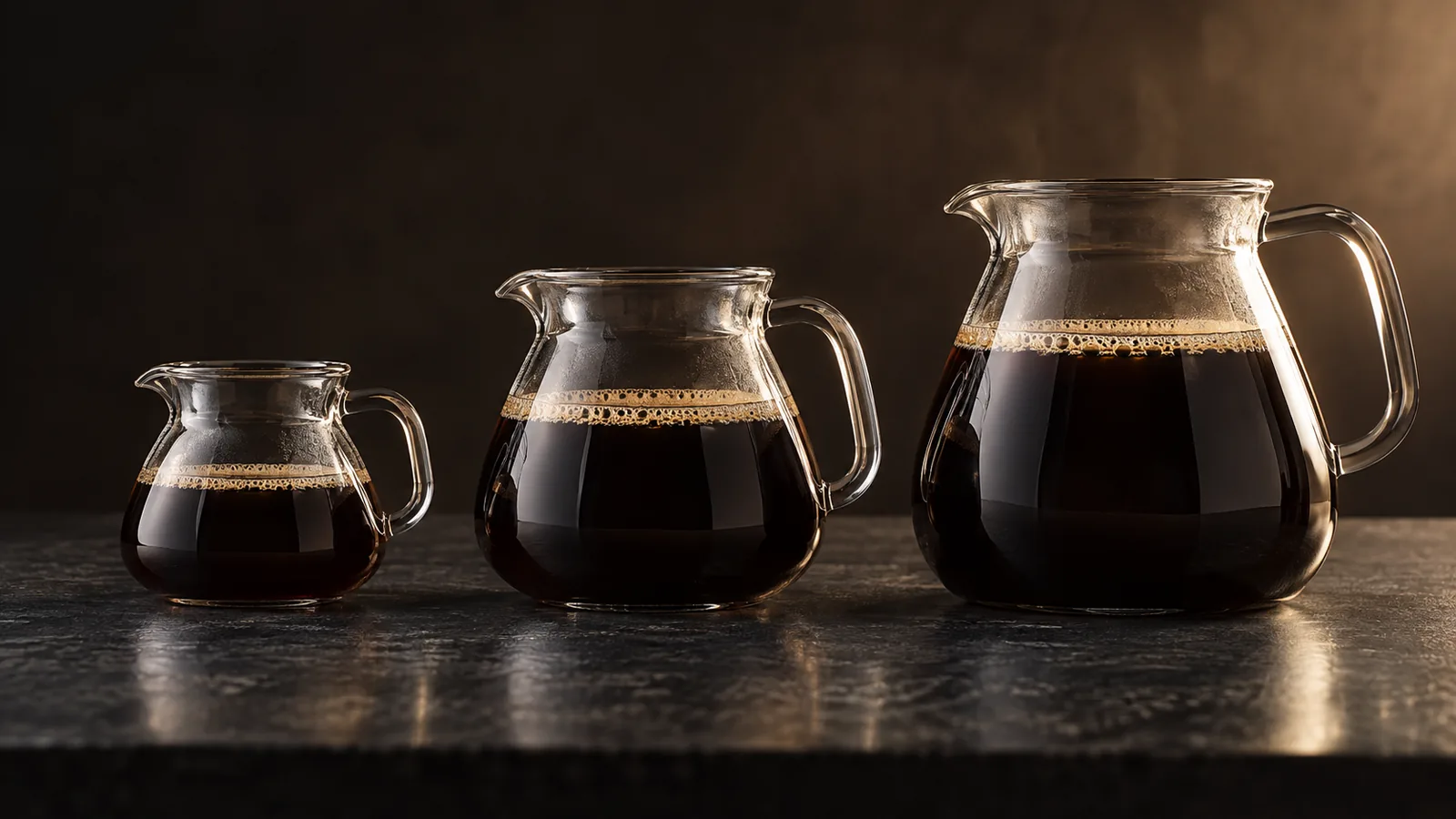
Before discussing which capacity to buy, the most important clarification: drip coffee maker capacities are measured in 5-ounce servings — not the 8-ounce cups a standard measuring cup holds.
| Machine rated capacity | Ounces produced | Standard 16-oz travel mugs |
|---|---|---|
| 4 cup | 20 oz | 1.25 mugs |
| 8 cup | 40 oz | 2.5 mugs |
| 10 cup | 50 oz | 3.1 mugs |
| 12 cup | 60 oz | 3.75 mugs |
| 14 cup | 70 oz | 4.4 mugs |
A buyer who pours coffee into 16-oz travel mugs and calculates they need “4 cups” would produce 32 ounces — a machine rated for 6–7 cups by the 5-oz standard. This mismatch is the source of considerable buyer frustration when machines do not produce what buyers expected.
The reliable number: always find the total ounces in the product specifications. “12-cup” is an ambiguous label; “60 oz” is not.
How much coffee to use for each size
Once you know your machine’s real capacity in ounces, the coffee follows a simple rule: about 1 to 1.5 level tablespoons of grounds per 5-ounce cup — less for mild, more for strong. By pot size:
| Machine size | Water | Ground coffee (medium strength) |
|---|---|---|
| 4 cup | 20 oz | 4–6 tbsp |
| 8 cup | 40 oz | 8–12 tbsp |
| 10 cup | 50 oz | 10–15 tbsp |
| 12 cup | 60 oz | 12–18 tbsp |
| 14 cup | 70 oz | 14–21 tbsp |
Tablespoons are approximate — grind and bean density vary — so weighing is more reliable: a level tablespoon of ground coffee is roughly 5 grams. For an exact dose at any size, use the coffee-to-water ratio calculator.
The capacity regret pattern
Analyzing buyer satisfaction data by machine capacity reveals a consistent pattern:
Buyers who own machines larger than they need report:
- Running the machine at 30–50% capacity most days
- Coffee that tastes weaker than expected (because partial-batch brewing mismatches the showerhead coverage to the grounds volume)
- Paying for and cleaning a large machine they never fully use
- Wishing they had bought a smaller, more appropriate machine
Buyers who own machines slightly smaller than their peak need (entertaining, weekends with guests) report:
- Making two batches when needed, which is mildly inconvenient
- Being satisfied with the machine for the other 350 days of the year
- Better daily coffee quality because the machine runs at or near rated capacity
The asymmetry is striking: very few buyers report regretting a machine that was slightly too small, because the workaround (a second batch) is trivial. Many buyers report regretting machines that are too large because the daily experience is consistently suboptimal.
Capacity by household
4-cup machines (20 oz / 1.25 travel mugs)
Right for:
- Single buyers who drink one standard mug per day
- Buyers with very limited counter space who want the smallest footprint possible
- Households where only one person drinks drip coffee
- Buyers who want to make fresh coffee twice a day rather than a large batch once
Not right for:
- Households where a second cup before leaving is common — 20 oz is tight for two moderate mugs
- Any household with two regular coffee drinkers
- Anyone who likes having coffee available over several hours
What to expect: 4-cup machines are typically lower-cost ($20–$60), have fewer features, and are less likely to carry SCA certification. The Hamilton Beach BrewStation and similar models serve this market. Quality varies widely at this tier.
8-cup machines (40 oz / 2.5 travel mugs)
Right for:
- Couples where both people drink 1–2 mugs in the morning
- Single buyers who want a larger batch — a morning cup plus a mid-morning refill plus some to spare
- Small households (2–3 people) with moderate consumption
Why it works: 40 ounces accommodates two standard mugs with room for one additional serving. A couple with different schedules can each pour their share without timing their morning precisely. There is a small buffer without enough surplus to create warming-plate-burning issues in a reasonable morning window.
The mid-range sweet spot: the $80–$150 range where SCA-certified machines begin (Breville Precision Brewer, OXO Brew) includes both 8-cup and 9-cup configurations. For couples or small households, the 8-cup SCA-certified machine is often the optimal purchase.
10–12 cup machines (50–60 oz / 3–4 travel mugs)
Right for:
- Families of 3–4 who all drink morning coffee
- Households that regularly host guests
- Remote-work households where one person makes a large batch and returns to it throughout the morning (with a thermal carafe — not glass)
- Office small-group use (3–6 people sharing a pot)
The risk: buyers in 1–2 person households who purchase 12-cup machines consistently report running the machine at 4–6 cup capacity and getting worse coffee as a result. The showerhead is designed to distribute water across a basket sized for 12 cups — at 4 cups, the coverage is insufficient and extraction is uneven.
When large is right: if you genuinely make and consume a full or near-full pot every morning, a 12-cup machine is correct. The question is whether your reality matches that description.
The partial-batch quality issue in detail
Drip coffee machines are designed to produce consistent extraction at their rated capacity. The showerhead distributes water across the filter basket based on assumptions about the grounds volume at that capacity. When you brew at 50% capacity:
- The water volume is insufficient to saturate all the grounds in the larger basket evenly
- Water finds the path of least resistance and channels through certain sections, over-extracting them while leaving others under-extracted
- The resulting coffee is uneven: some parts of the batch are bitter (over-extracted), others are sour or thin (under-extracted), and the combined result tastes worse than either extreme
This effect is less pronounced in machines with wide, multi-hole showerheads that distribute water more broadly. It is most pronounced in machines with a single-point or narrow-spray outlet. SCA-certified machines that require even extraction as part of certification tend to handle partial batches better, but none are optimized for half-capacity brewing.
The solution: if you routinely brew 4–6 cups, buy a 4–6 cup machine. Use the larger machine only if you routinely fill it.
Counter space vs capacity trade-off
Larger-capacity drip machines are uniformly wider and taller than compact models. If counter space is limited, this is a real constraint that should weigh against buying up.
| Category | Typical footprint |
|---|---|
| 4-cup compact | 7–8” wide × 8–10” tall |
| 8-cup mid-size | 8–10” wide × 12–14” tall |
| 12-cup full-size | 10–12” wide × 14–16” tall |
A 12-cup machine takes 40–70% more counter width than a 4-cup machine. For buyers with limited counter space who are considering a 12-cup machine for occasional hosting, a better solution is usually an 8-cup machine for daily use and a French press or pour-over for the occasions when more is needed.
Decision guide
| Household and drinking pattern | Recommended capacity |
|---|---|
| One person, 1 mug/day | 4-cup |
| One person, 2 mugs/day or large mug | 6–8 cup |
| Two people, 1 mug each | 6–8 cup |
| Two people, 2+ mugs each | 8–10 cup |
| Family of 3–4, daily coffee drinkers | 10–12 cup |
| Regular entertaining or office | 12–14 cup |
| One person with guests sometimes | 4–8 cup for daily + second method for guests |
Settled on a capacity? See our top drip coffee maker picks for the best models at each size.
Our overall pick — Ninja 12-Cup Programmable. Whatever capacity you land on, this is the all-rounder owners trust most:
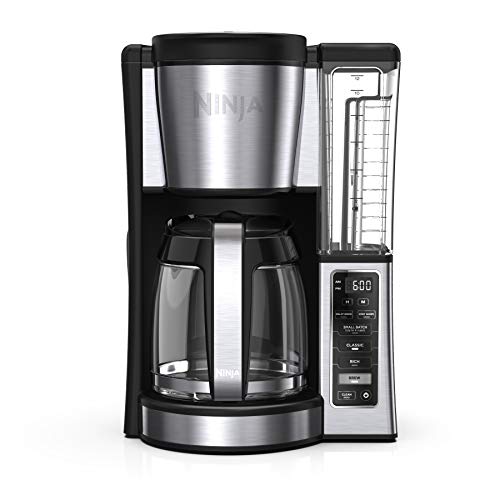
Ninja 12-Cup Programmable Coffee Brewer
The best all-round drip coffee maker. Owners reward it for temperature retention, ease of cleaning, ease of use, and quality — all above the norm — on the largest ownership base among mainstream machines, and it carries no distinctive weakness. Multiple brew styles plus a programmable timer cover the everyday routine. The one caveat is a carafe that can drip when pouring, so buy with an easy return window.
Prime Day Amazon Prime Big Deal Days is on — a good time to check the live price.
Check current price on AmazonWhat buyers praise
- No distinctive weakness — the cleanest profile in the category
- Rewarded for temperature retention, cleaning, ease of use, and quality
- Largest ownership base among mainstream machines — trustworthy signal
- Multiple brew styles plus a programmable timer
What buyers flag
- Carafe can drip when pouring — the category-wide caveat
- 12-cup — large households may want the Cuisinart 14-cup
- Not SCA-certified
How to choose a drip coffee maker · Glass vs thermal carafe · Coffee-to-water ratio calculator