The mechanism
Yogurt is fermented milk. The fermentation is biological, not chemical — specific strains of bacteria consume lactose (milk sugar) and produce lactic acid as a byproduct. The acid lowers the milk’s pH, which causes the milk proteins to tangle and form a gel. That gel is yogurt.
The bacteria responsible — primarily Lactobacillus delbrueckii subsp. bulgaricus and Streptococcus thermophilus — are thermophilic, meaning they function best at elevated temperatures. Their optimal range is 105°F to 115°F (40°C to 46°C). Below 105°F, the bacteria become sluggish: fermentation slows or stalls, and the batch may sit for 12 hours without fully setting. Above 115°F, the cultures begin to die. A machine that runs hot does not produce faster yogurt — it produces a failed batch.
A yogurt maker’s job is to maintain a stable temperature within this 10-degree window for the duration of the incubation. Nothing else it does matters more than that — which is why, if your batches keep failing, the first thing worth checking is whether the machine actually holds temperature: see how to test your yogurt maker for temperature drift.
Yogurt maker temperature: the exact numbers
Because temperature is the entire job, it is worth stating the numbers plainly. Every threshold below describes the incubation environment the machine holds — not the separate milk-heating step that comes before it.
| Temperature | What happens to the cultures |
|---|---|
| Below 100°F (38°C) | Barely active — fermentation stalls or drags past 14 hours |
| 105–115°F (40–46°C) | The viable window — cultures ferment efficiently |
| ~110°F (43°C) | The standard target most machines aim for |
| Above 115°F (46°C) | Cultures begin to die — the batch thins or fails |
| Above 130°F (54°C) | Cultures are killed outright |
Do most yogurt makers let you set the temperature? No — and this surprises buyers. The large majority of home yogurt makers have no adjustable temperature control at all. They use a fixed-wattage heating element tuned to land near 110°F in a normal-temperature kitchen and hold that single setting; a digital display showing a temperature is usually reporting the target, not measuring and regulating the actual internal temperature. Genuine adjustable, thermostatically regulated control appears mainly on higher-end and specialty machines — for example, those built for 24-hour SCD fermentation. For everyday dairy yogurt, a fixed ~110°F is all you need. What matters is whether the machine holds that number steadily across the whole incubation, which is why verifying it once with a thermometer beats trusting the display.
What the machine actually does
Most yogurt makers use a low-wattage heating plate or element in the base unit. The mechanism is straightforward:
- The user fills jars or a container with inoculated milk (milk that has had a starter culture mixed in)
- The jars are placed in the machine and the lid is closed
- The heating element warms the air or the base of the jars to the target temperature
- The machine holds that temperature passively — most models do not have active temperature regulation; they rely on the stable heat output of a fixed-wattage element in an insulated housing
- After 6 to 10 hours, the user removes the jars and refrigerates them to stop fermentation and firm the texture
The simplicity is intentional. Yogurt does not require anything more complex. The danger is in the simplicity: a heating element that produces inconsistent output, a housing that loses heat to ambient temperature, or a lid that fits poorly enough to allow significant heat loss will produce unreliable results regardless of how carefully the user follows the recipe.
How to use a yogurt maker, step by step
Once you understand that the machine’s only job is temperature, using one is straightforward:
- Heat the milk to about 180°F, then let it cool to below 115°F. This denatures the milk proteins for a thicker set. (Ultra-pasteurized milk can skip the heating step.)
- Add the starter once the milk is cool enough not to kill it — a spoonful of plain live-culture yogurt, or a powdered culture. Stir it in evenly.
- Fill the jars or container and place them in the machine.
- Close the lid and switch it on. The machine holds the batch near 110°F; you do nothing while it incubates.
- Wait 6 to 10 hours. Shorter is milder and looser; longer is tangier and firmer.
- Refrigerate at least 4 hours. This stops fermentation and firms the texture — a just-finished batch always looks softer than the final result.
The machine controls only step 4’s temperature. Everything else — the milk, the starter, and your timing — is up to you, which is why a reliable incubator matters but is not the whole story.
Why temperature consistency matters more than the target number
Most yogurt makers are advertised as operating at “around 110°F” or “optimal yogurt temperature.” What the advertisement does not tell you is whether the machine holds that temperature consistently across all positions in the machine and across a 10-hour incubation.
The failure modes buyers most commonly report are:
Runny or unset yogurt. Almost always caused by the machine running cooler than the target, especially in cold ambient conditions. A machine calibrated to 108°F in a 72°F kitchen may run at 102°F in a 65°F kitchen in winter. The cultures are alive but sluggish; the batch needs several more hours than expected, and if the user removes the jars on schedule, the yogurt is still liquid.
Overly sour or grainy yogurt. Less common but caused by the machine running hotter than intended, or by the outer jars running hotter than the center jars if the heating element is uneven. Cultures that have been working at 113°F for 10 hours produce a sharply acidic result with a slightly grainy texture as the proteins begin to break down.
Inconsistent results across jars. A machine with an uneven heating base will produce firmer yogurt in the jars closest to the heating element and thinner yogurt in the outer positions. This is the most common quality-control failure in budget jar-style machines.
Verifying a machine’s actual temperature with an instant-read thermometer inside a jar of water — before the first real batch — takes two minutes and eliminates the most common source of failed batches.
The two form factors and what they mean for temperature
Yogurt makers come in two physical configurations. The configuration determines how heat is distributed and how many jars can be processed simultaneously.
Individual jar models
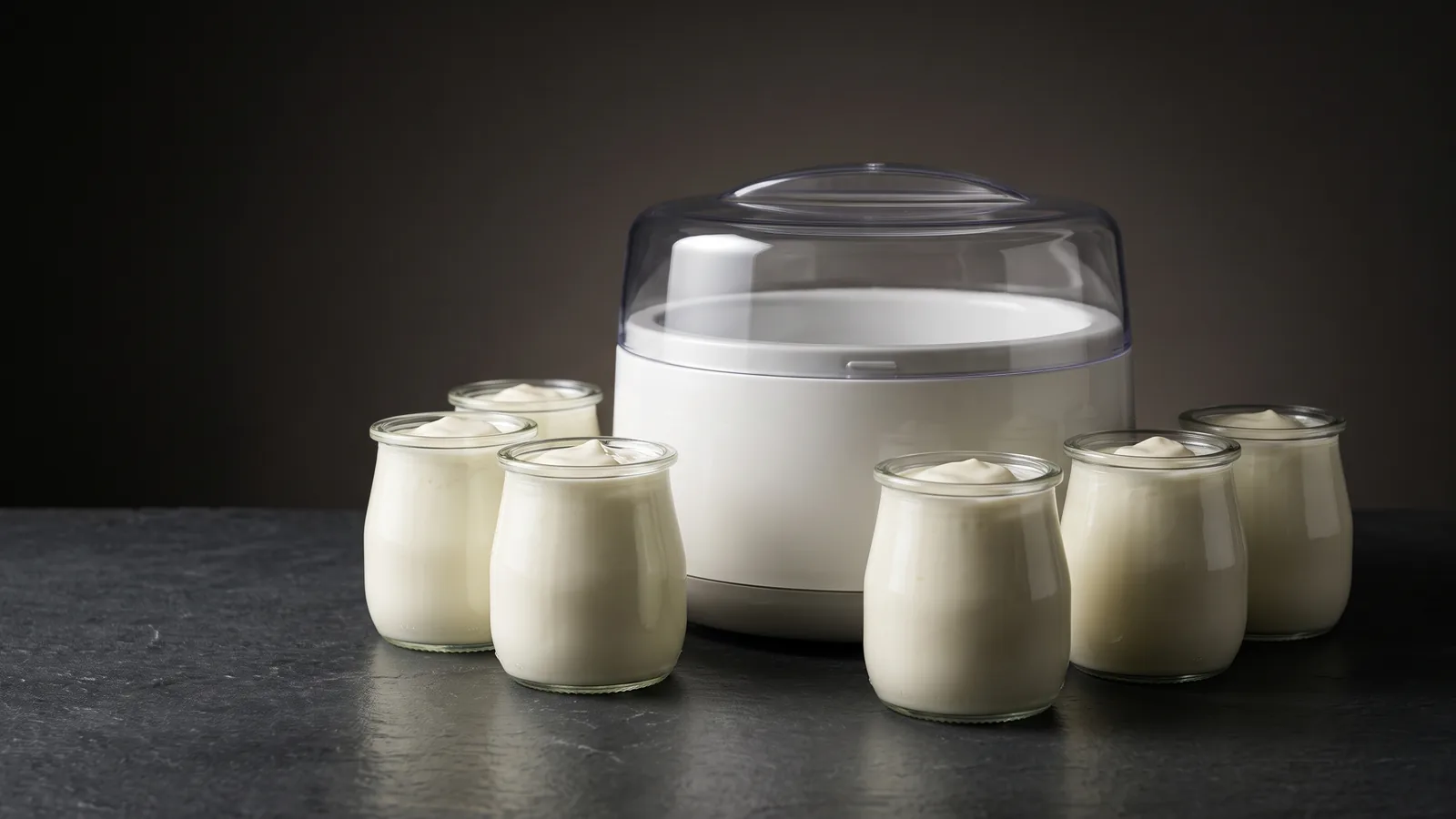
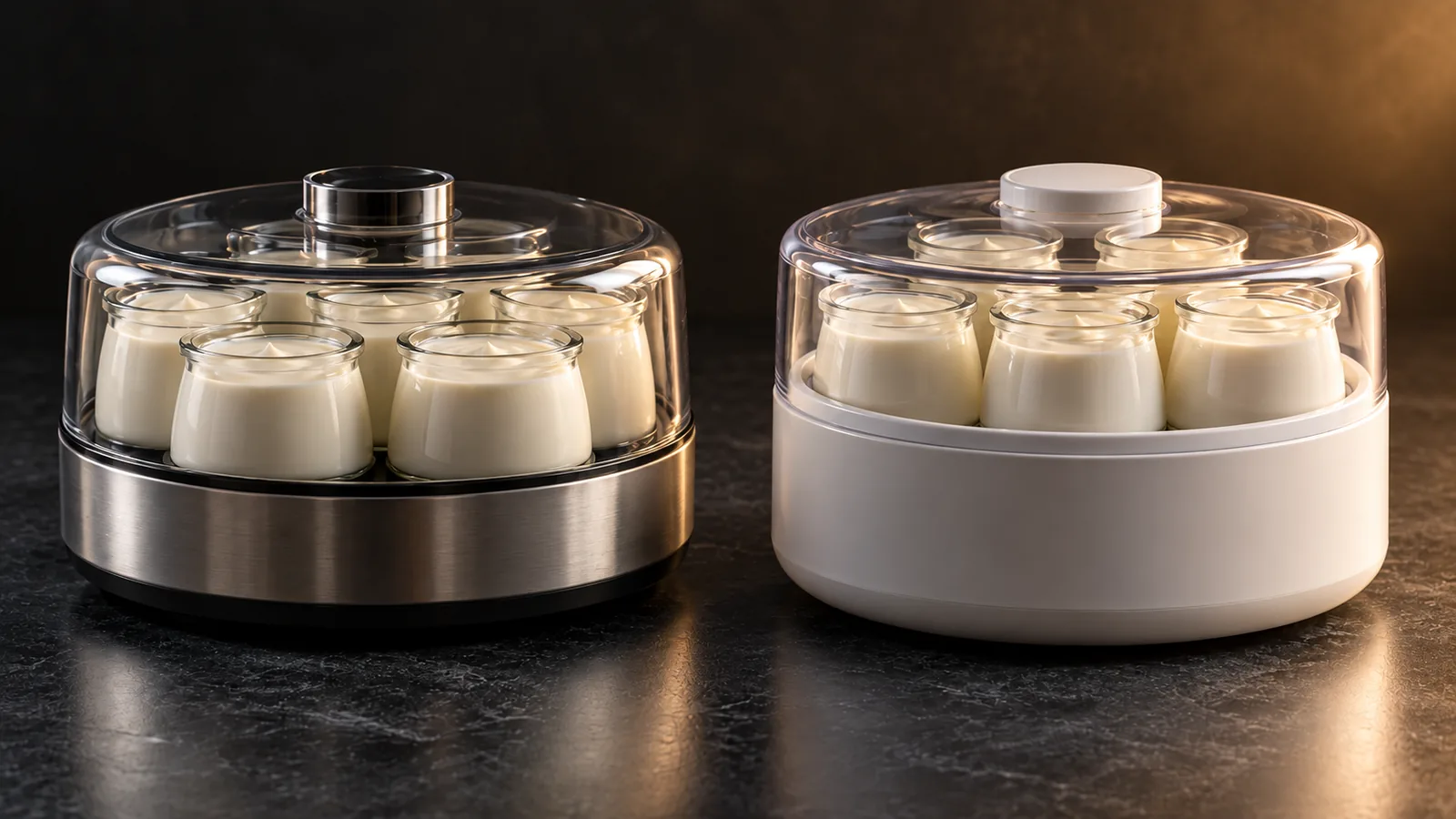
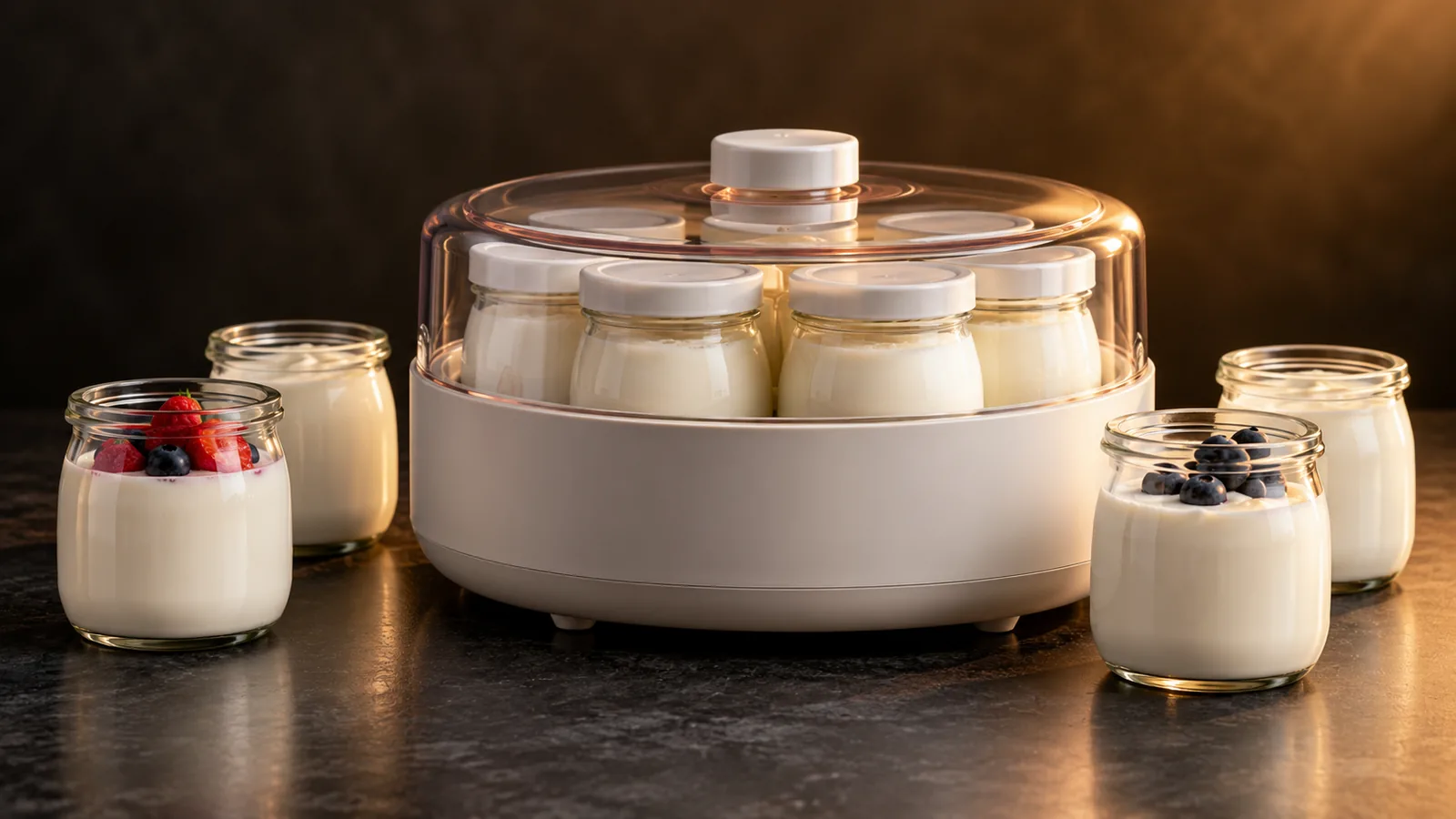
The most common type. A heating base holds 4 to 8 small glass or plastic jars (typically 6 to 8 oz each). The jars sit on or around the heating element; a domed lid covers the assembly.
The advantage is portion control and batch flexibility — jars can be flavored individually, incubated for different durations if removed at different times, and stored directly in the refrigerator in the same jar.
The temperature risk is position variability. Jars on the perimeter of a round base receive less direct heat than jars in the center. In well-designed machines, the base is sized and calibrated to produce even heat across all positions. In budget machines, the spread can be significant enough to produce inconsistent results across jars in the same batch.
Single-container models
A single vessel — typically 1 to 2 quarts — sits on or in the heating unit. Heat is applied evenly to the entire container, which eliminates the position-variability problem. A single batch produces more yogurt but less flexibility.
Single-container models tend to hold temperature more reliably because there is no air gap between jars and the heat is applied to a uniform mass. They are the better choice for buyers who prioritize consistency over variety.
Most people start with the individual-jar type for its flexibility — the catch, as above, is the position-variability problem, which a well-calibrated base solves. If you’ve decided a yogurt maker is for you, this is the individual-jar machine we’d point most people to.

Euro Cuisine YMX650 Automatic Yogurt Maker
The individual-jar machine that gets the fundamentals right. Its base is calibrated for even heat across all seven jar positions — directly addressing the position-variability problem that makes budget individual-jar makers inconsistent — and a preset fermentation temperature plus an auto-shutoff timer make it genuinely hands-off. Owners report the same quality dairy yogurt as far pricier machines, and the seven glass jars let you make several flavours at once and store them in the same jar. It's not the tool for 24-hour SCD or long plant-based fermentation (that needs a variable single-container model), but for everyday dairy yogurt it's the pick.
Prime Day Amazon Prime Big Deal Days is on — a good time to check the live price.
Check current price on AmazonWhat buyers praise
- Even heat across all jar positions — avoids the budget-maker inconsistency
- Hands-off: preset temperature plus auto-shutoff timer
- Seven glass jars for multiple flavours; same quality as pricier machines
What buyers flag
- Preset temperature — not for 24-hour SCD fermentation
- Individual jars make bulk Greek straining less convenient
What the timer and auto-off actually do
Many yogurt makers include a countdown timer and automatic shutoff. The function is exactly what it sounds like: the machine runs for the set duration, then cuts power.
What the timer does not do: extend or shorten fermentation after shutoff. Once the machine turns off, the jars cool gradually. If the ambient temperature is warm (above 75°F), fermentation continues slowly as the batch cools, and a 7-hour machine cycle may produce a result closer to 8 or 9 hours of effective fermentation. If the kitchen is cold, the batch cools quickly and fermentation stops promptly.
The practical implication: the timer is a convenience tool, not a precision fermentation controller. Buyers who want precise control over sourness and texture should check the batch by sight and taste rather than relying solely on the timer.
What a yogurt maker cannot do
Make yogurt faster. The fermentation is biological. Raising the temperature above the viable range does not speed fermentation — it kills the cultures. A machine that runs hotter does not produce yogurt in fewer hours; it produces a failed batch.
Fix bad starter. If the starter culture is dead (old, improperly stored, or kept too long after opening), no amount of incubation time will produce yogurt. Starter should be refrigerated, used within the date on the package, and kept away from direct contact with hot milk — the starter is added after the milk has cooled to below 115°F.
Determine whether yogurt is Greek. Greek yogurt is strained regular yogurt. The machine incubates; the user strains. A machine with a built-in strainer accessory makes this more convenient but is not doing anything different mechanically.
Replace refrigeration. Finished yogurt must be refrigerated. Room-temperature incubation is the process; room-temperature storage is a food safety problem.
The yogurt maker vs. other incubation methods
A dedicated yogurt maker is not the only way to incubate a batch. The alternatives — Instant Pot, oven, slow cooker, insulated bag — all work on the same principle and all have real trade-offs compared to a dedicated machine.
Full comparison: Yogurt Maker vs Instant Pot Yogurt Setting
The short version: the dedicated machine wins on reliability and hands-off convenience. The Instant Pot wins on batch size and versatility if you already own one. The oven and insulated-bag methods work but require more active monitoring and are less consistent in cold kitchens.
Summary: the mechanism in one table
| What the machine does | Why it matters |
|---|---|
| Heats to ~110°F (43°C) | Activates thermophilic bacterial cultures |
| Holds temperature for 6–10 hours | Allows fermentation to complete fully |
| Insulates against ambient temperature | Prevents heat loss that stalls fermentation |
| Provides individual jars or a single container | Determines portion flexibility vs. temperature consistency |
| Shuts off automatically (if timer-equipped) | Convenience only — does not control fermentation chemistry |
The machine that holds 110°F most consistently, across all positions and across a full 10-hour incubation, will produce the most reliable results. Every other feature — jar count, lid design, digital display, included accessories — is secondary to that single performance criterion. If you already know what you need, jump to our best yogurt makers of 2026 for the picks by use case.
How to make yogurt at home · Next: How to choose a yogurt maker based on what matters · See the top picks