Start with form factor, not features
The yogurt maker market splits cleanly into two designs. Every other buying consideration sits downstream of this one.
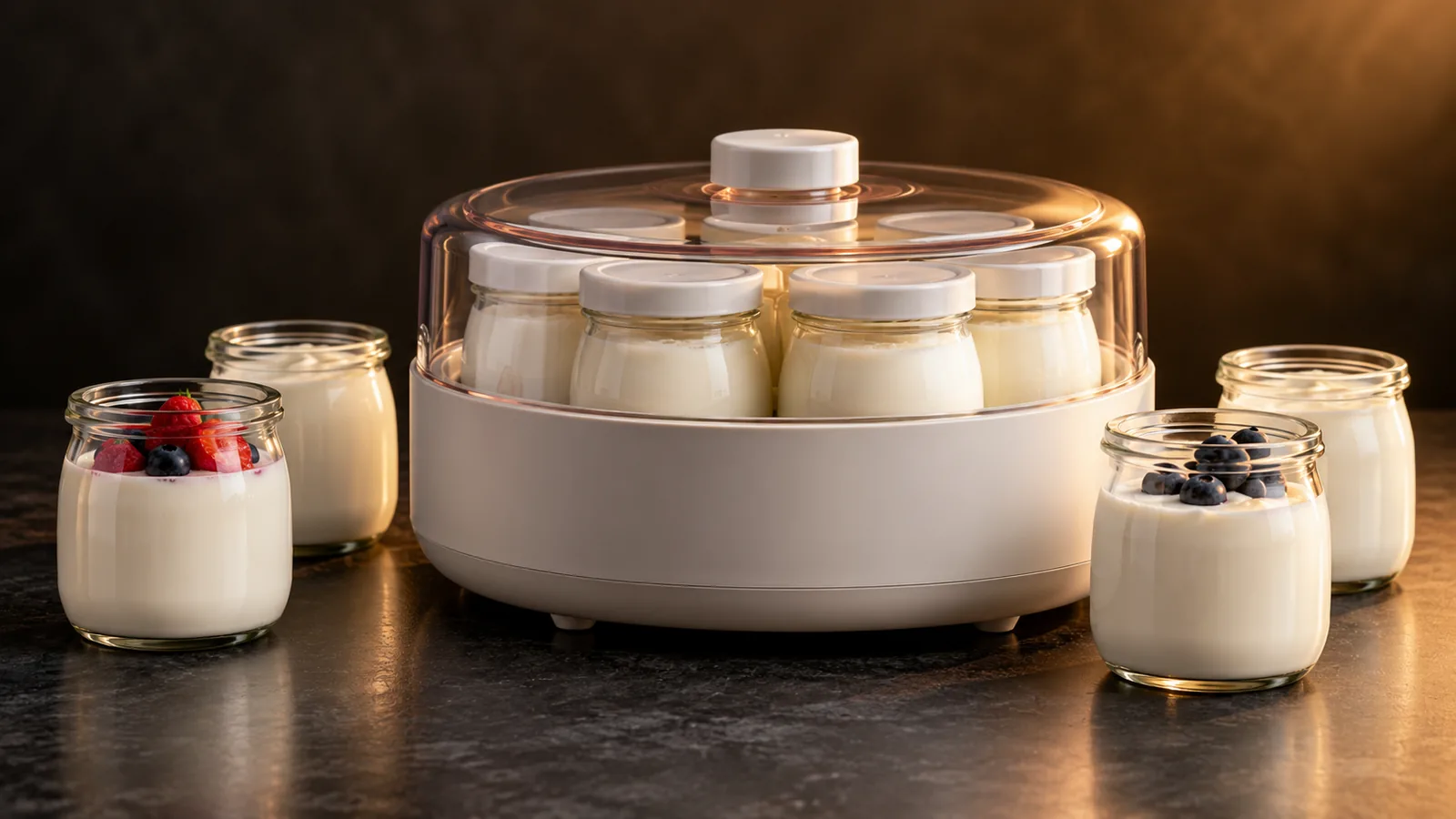
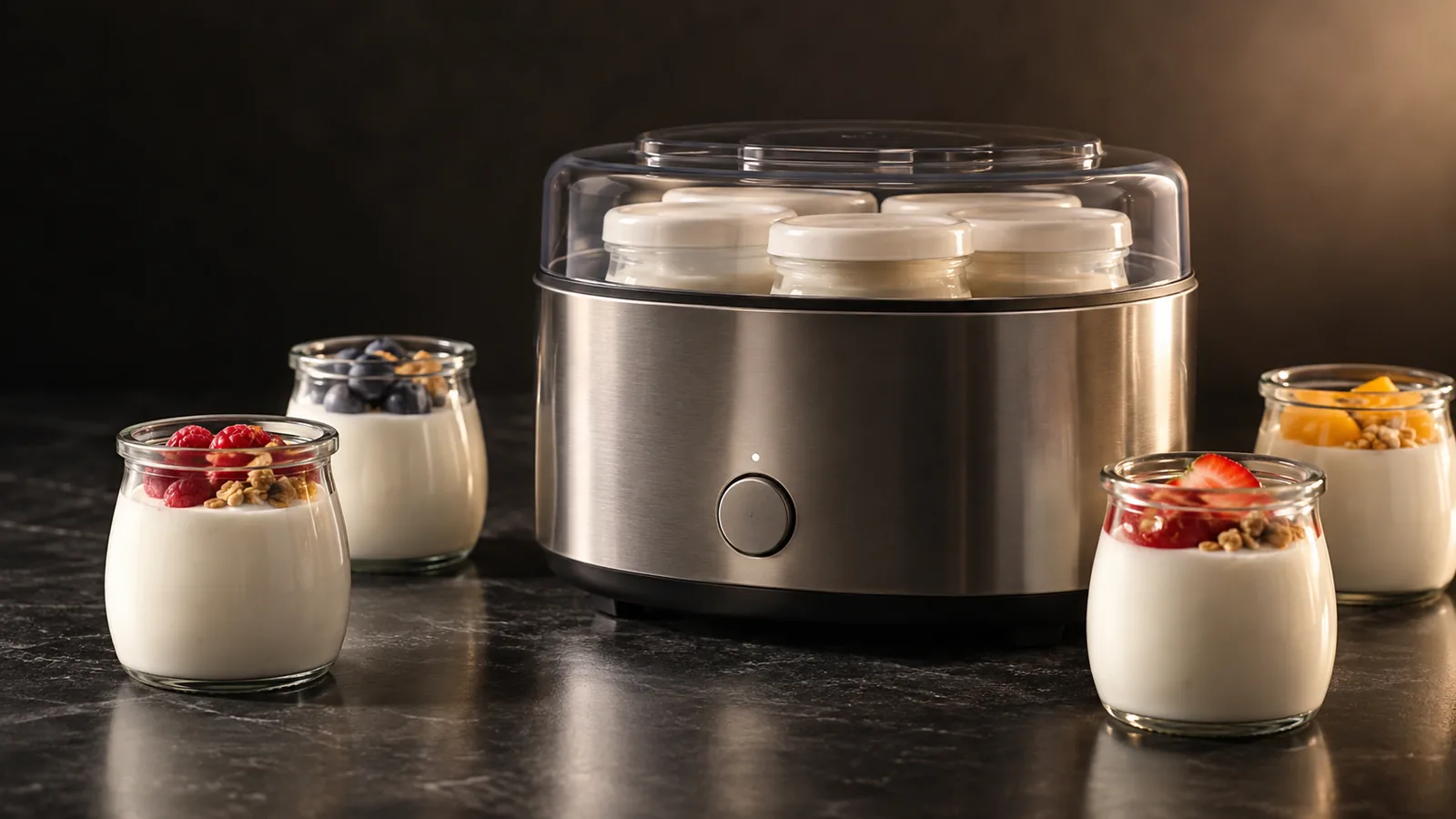
Individual jar models hold 4 to 8 small jars (typically 6 to 8 oz each) arranged in a heated base under a domed lid. The user fills each jar individually, places them in the machine, and retrieves them at the end of incubation. Each jar goes directly into the refrigerator; there is no transfer step.
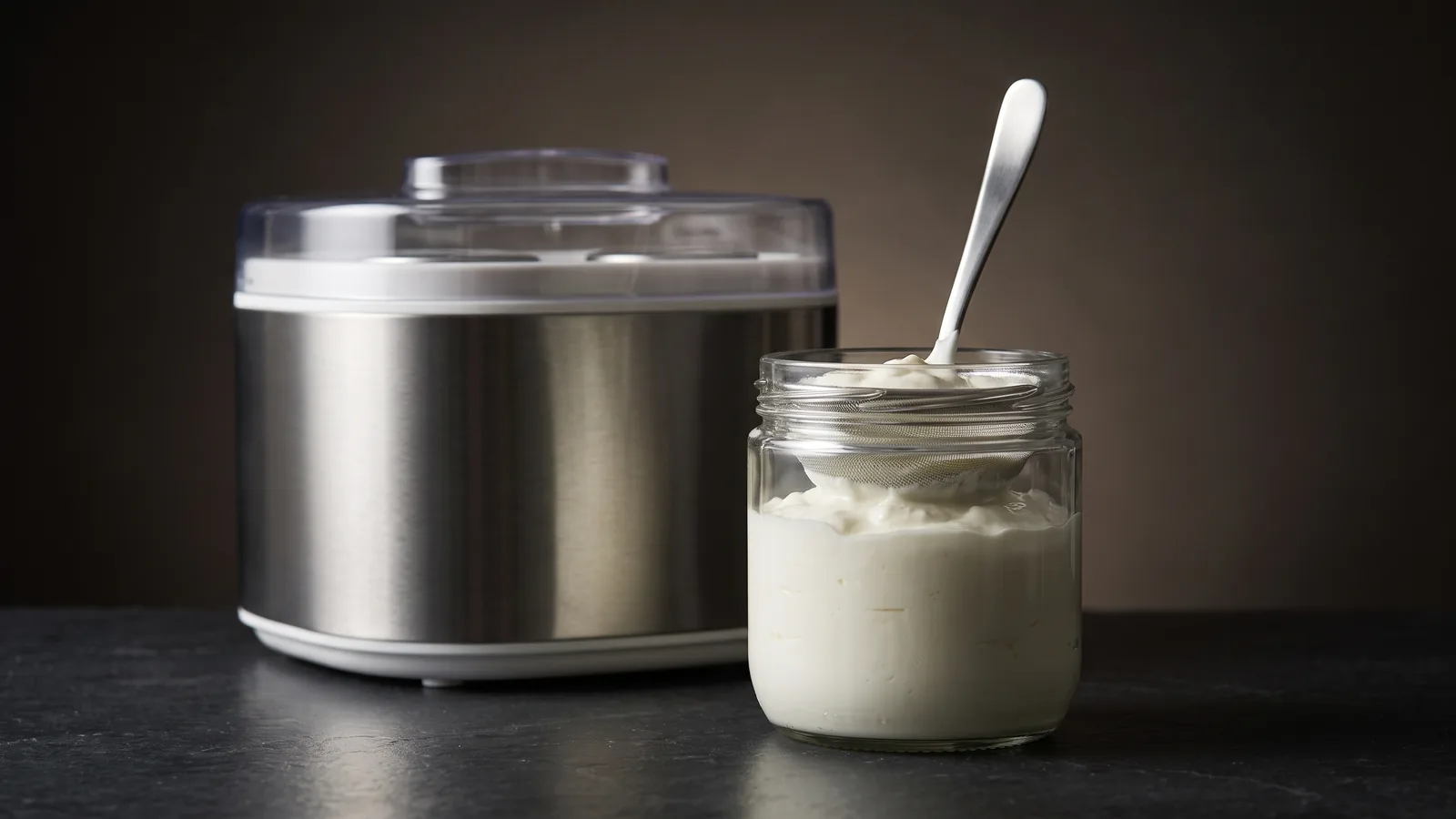
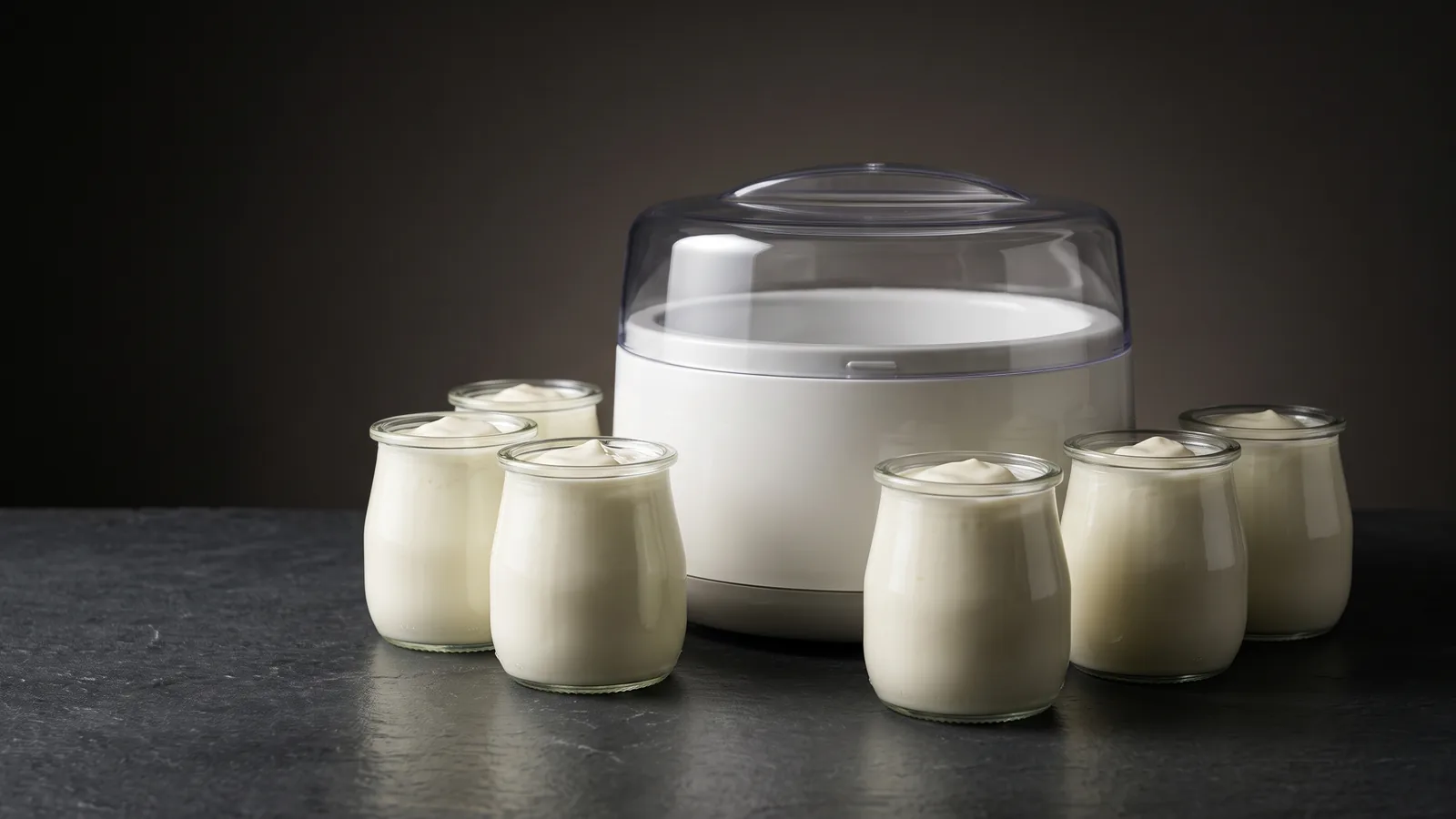
Single-container models use one vessel — typically 1 to 2 quarts — that sits in or on the heating unit. The user makes one batch, transfers it to serving containers after incubation, or stores it in the machine vessel if the vessel is designed for refrigerator use.
The choice is not about quality — both types can produce excellent yogurt. It is about how the machine fits into a household’s actual routine.
When to choose individual jars
Individual jar models make sense when:
Portion control matters. Each jar is one serving. Users can add different flavors to different jars before incubation — fruit, honey, vanilla — and store each jar individually. There is no cutting or scooping from a single container.
Batch flexibility matters. Jars can be removed at different times during incubation to produce a range of sourness levels in the same batch. The jars incubated for 6 hours will be milder than the jars left for 9 hours.
Direct refrigerator storage is convenient. The jars go from the machine to the refrigerator without any transfer. For buyers who have limited refrigerator containers or who prefer minimal cleanup, this is a real convenience advantage.
The household makes yogurt for one or two people. Four to six 6-oz jars produces 24 to 36 oz per batch — enough for a few days for a single person or one day for two.
The main disadvantage of jar models is position variability: jars at the perimeter of a round heating base typically receive slightly less heat than jars in the center, producing minor batch inconsistency. In well-engineered machines this is negligible; in budget machines it is a real source of uneven results.
When to choose a single container
Single-container models make sense when:
Batch size matters. A 1.5- to 2-quart container produces significantly more yogurt per cycle than a 4-to-6-jar arrangement. For families or buyers who go through yogurt quickly, fewer cycles per week is a genuine convenience.
Temperature consistency is the priority. Heat applied to a single large mass of milk distributes more evenly than heat applied through a base plate to multiple small jars with air gaps between them. Single-container machines tend to be more reliable in cold ambient conditions for the same reason.
Greek yogurt is the primary goal. Straining a single large container of yogurt is more practical than straining 6 individual small jars. A single container makes the straining step — which is just pouring through cheesecloth into a bowl — straightforward.
The main disadvantage is that serving requires scooping from a shared container, and the container may not be designed for long-term refrigerator storage. Check whether the machine’s vessel has a proper lid for refrigerator use before buying.
Capacity: the most common source of regret
Buyer reports across the yogurt maker category consistently identify capacity as the feature buyers most often get wrong — almost always in the direction of too small.
The math is simple. A typical 6-oz jar holds one serving. A machine with four jars produces four servings per batch. If a household of two people eats yogurt daily, that is enough for two days. Two batches per week at 6 to 10 hours each means the machine is running four or more times per week, often simultaneously with other kitchen activity.
A machine with seven or eight jars — or a 1.5- to 2-quart single container — reduces the cycle frequency by half. For most buyers, that is the better fit.
The practical guideline: estimate weekly household yogurt consumption in cups, divide by the machine’s batch yield, and ask whether running the machine that many times per week is realistic. If the answer is more than twice a week, move up in capacity.
Temperature performance: the one technical specification that matters
Every yogurt maker lists a target temperature. What matters is whether the machine actually achieves and holds that temperature consistently across all positions and across a full 10-hour incubation.
Manufacturers do not typically publish temperature tolerance data. The practical proxy is:
- Budget machines under $30: temperature consistency is the category’s weakest point at this price. Results vary between machines of the same model and degrade as ambient kitchen temperature drops.
- Mid-range machines ($30–$70): most major brands in this range perform adequately in normal kitchen conditions (68–75°F ambient). Performance in cold kitchens (below 65°F) is less reliable.
- Premium machines ($70+): active temperature regulation (a thermostat rather than a fixed-wattage element) provides meaningful performance improvement in variable ambient conditions.
The simplest verification: before the first real batch, fill a jar with water, place it in the machine, run it for one hour, and measure the water temperature with an instant-read thermometer. A reading between 105°F and 115°F confirms the machine is in range. A reading below 105°F or above 115°F explains any future failed batches.
Timer and auto-off: useful but not essential
A timer that shuts the machine off after a set incubation period is a genuine convenience — the user does not need to remember to check or turn off the machine. Most yogurt makers at mid-range and above include this feature.
What the timer does not do: precisely control the yogurt’s flavor profile. Fermentation continues slowly as the batch cools after shutoff, and ambient temperature affects how quickly the batch cools. The timer sets the minimum incubation duration, not a precise endpoint.
For buyers who want consistent results, a timer is helpful. For buyers who check the batch by taste anyway, it is optional. A machine without a timer and with reliable temperature control will outperform a machine with a timer and inconsistent temperature.
Features that appear on spec sheets but matter less than they seem
Digital display. Shows incubation time remaining or current temperature. Useful for monitoring; does not affect the yogurt.
Lid viewing window. Allows checking batch status without opening the lid. Marginally convenient; opening the lid briefly to check a batch does not meaningfully affect incubation.
Extra-large jar lids vs. pour lids. Jar lids serve two purposes: covering during refrigerator storage and preventing contamination during incubation. The style matters less than whether the lid seals adequately for refrigerator use.
Included recipe booklet. Present in most packages; yogurt making is simple enough that a recipe booklet adds little over the three-step basic process (heat milk, cool to 110°F, add starter, incubate).
“Yogurt mode” on multi-function machines. Some blenders, multi-cookers, and other appliances include a yogurt mode. These can work — the Instant Pot’s yogurt setting is the most established example — but the mode is an afterthought in the product’s design, and temperature consistency varies more than in a dedicated machine. Full comparison here.
The decision in brief
| If your priority is… | Choose… |
|---|---|
| Portion control and flavor variety per batch | Individual jar model, 6–8 jars |
| Large batch efficiency | Single-container model, 1.5–2 quart |
| Temperature consistency | Single-container, or mid-range jar model with verified temp |
| Greek yogurt as primary use | Single-container (easier straining) |
| Minimal investment to try yogurt making | Budget jar model, 4–6 jars |
| Daily use for a family | Single-container or 8-jar model |
The machine that holds 110°F reliably and produces the batch size the household actually needs is the right machine. Brand, aesthetics, and accessories are secondary to those two criteria.
Next: Yogurt Maker vs Instant Pot — which is actually better for home yogurt making · Best yogurt makers of 2026